Posts filed under 'recipe'

Nearly Raw Tahini Noodles

Nearly Raw Tahini Noodles

It’s officially Summer; I can’t deny it any longer. I’m eating way more than my fair share of tofu sandwiches, and even the heat emanating from the toaster can be too much for me sometimes. If you can find some part of the day to boil noodles (in the cool of the morning, or before bed), you can make them ahead of time and be done with the only cooking required for this dish.

Earlier this year I was reading Coconut and Lime, and where Rachel had the brilliant idea of making a peanut sauce without peanuts. Her stand-in was sesame paste, and she created a fabulous sesame noodle dish that I couldn’t get out of my head. I absolutely had to make a sauce based on sesame paste. My recipe is different than hers (though hers is mighty tasty, so if you don’t care for my version give hers a try), but she was definitely the inspiration for this sauce that has quickly become a staple in my house.

Notes on Tahini and Sesame Paste
I use tahini in this recipe, which is a paste commonly used in the Middle East made from hulled sesame seeds.  The seeds can be raw or roasted, and the flavor will vary depending on which one you choose.  My favorite tahini is Arrowhead Mills Organic Sesame Tahini, which is unroasted.  It’s not too bitter, and it stays smooth and easy to use even after refrigeration.  Roasted tahini will also work great in this recipe, but the flavor will be noticeably different

Sesame paste, on the other hand, is an Asian ingredient that turns the whole sesame seed, including the hulls, into a paste.  It’s stronger than tahini, so you usually need much less in your recipes, and using too much can cause the dish to be more bitter than you expected.  While you can find tahini at any supermarket now (look near the peanut butter), Asian sesame paste still seems religated to specialty markets.

Tahini Noodle Prep

This dish is largely raw, which cuts down on a lot of the work, and prevents your summer kitchen from becoming a sauna. I’ve found that if you cut your veggies small enough and have a great sauce, you’ll be surprised at what you can serve raw. If you like, you can lightly steam the broccoli, but it really is tasty simply cut into tiny florets. If you follow a raw food diet, feel free to substitute the cooked wheat noodles with cucumber or zucchini noodles, or whatever raw noodles make you the happiest. Pretty much anything will work as the base of this dish.

The other benefit this dish is that it keeps really well, so I like to make a big batch to keep in the fridge for lunches, snacks, or meals to go.

Oh! And one more thing! Have you tried Whole Foods’ whole wheat spaghetti yet?  It tastes exactly like regular spaghetti, only it’s better for you than the stripped down stuff.  If you’re looking to add more whole grains into your diet, this is a super easy–even unnoticeable–way to do it.  They are by far the best whole wheat noodles I’ve ever had.

Nearly Raw Tahini Noodles
Serves 4 to 6

1/2 lb  Whole Wheat Spaghetti, cooked, rinsed in cold water, drained
2 Carrots, peeled and shredded
1/4 Green Cabbage Head, shredded
1 Stalk Broccoli, florets only, cut very small
A Handful Fresh Mint, chopped, optional (cilantro or basil would be good, too)
Sesame Seeds and More Mint, for garnish

Tahini Sauce
1/4 Cup Tahini, see section above
2 Tbs Low Sodium Tamari, or nama shoyu, or regular soy sauce
3 Tbs Water
1 Tbs Sugar, or raw agave nectar
1 Tbs Rice Vinegar
1 tsp Chili Sauce or 1 Chopped Fresh Chili
1 tsp Dijon or Stone-ground Mustard
1 Pinch Salt, if needed
Lots of Fresh Black Pepper

Cook the noodles and rinse under cold water. Drain and set aside, coating lightly with oil if desired to prevent the noodles from sticking. These can be made well in advance.

Coring CabbageCut your cabbage into quarters, then use a large chef’s knife to remove the core from one of the quarters, as shown at left. Discard the core, and wrap up the other three quarters for later use.

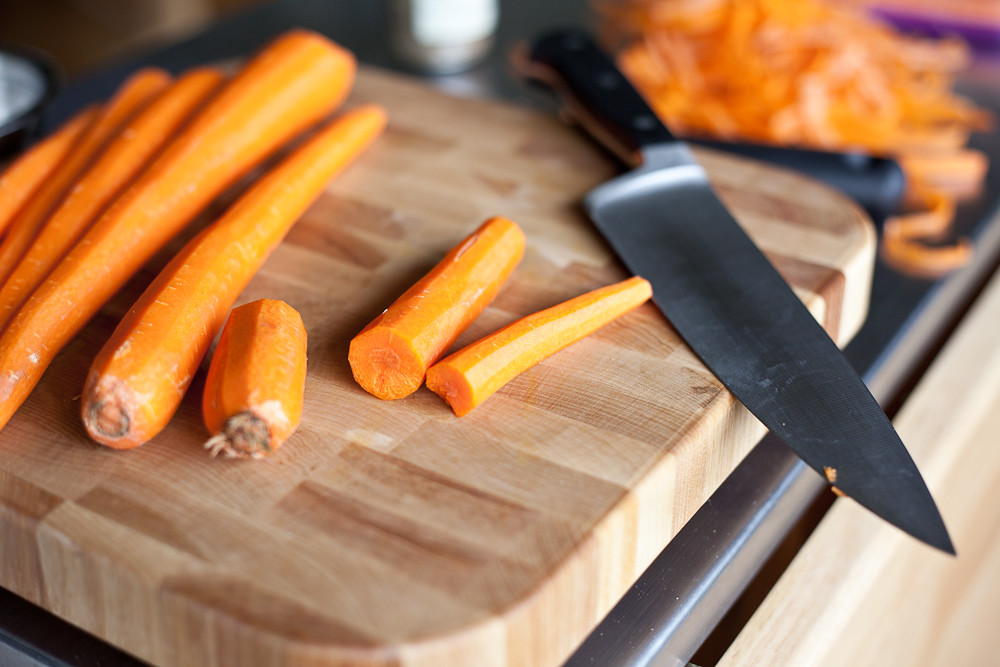
If you have a food processor, use it to shred your carrots and your cabbage. Use the shredder blade that has many holes for the carrots, and the blade that has one single slit for the cabbage. A box grater will work just fine for the carrots and a knife for the cabbage if a food processor is not available.

Chop the broccoli into small florets, creating pieces no bigger than small grapes. Toss all the veggies together and add the pasta. Stir together the sauce, tasting to adjust if needed.

When you’re ready to serve, add the sauce to the noodles and veggies and toss with your hands, coating everything evenly. Add chopped mint at the last moment, if using. Garnish with more mint and sesame seeds.

Nearly Raw Tahini Noodles

This will easily keep for a couple days. If you’re a big fan of sauce, you may want to double the recipe. This recipe makes just enough to coat the noodles.  Extra sauce will really come in handy after the completed dish has been refrigerated for a bit; I find noodles really soak up sauces so it can be nice to have some extra on hand.

If you’ve tried tahini and disliked it, give it another chance. It’s kind of vile on its own, so balancing flavors is very important with this ingredient. If you want a little tahini flavor but can’t quite use the full 1/4 cup, consider adding some peanut butter in lieu of tahini. Personally, I find this a really refreshing change from the typical peanut sauces, and since it’s so easy to make, why not give it a shot?

Nearly Raw Tahini Noodles

45 comments July 3rd, 2008

Crumb Cake

Crumb Cake

I’ve been looking for the perfect vegan crumb topping for a while now. Before today, my crumb toppings had always been sort of soggy, sort of greasy; more crummy than crumby. I wasn’t sure how to fix the problem.

About a month ago, I subscribed to Cook’s Illustrated. My mother used to get a subscription years ago that I loved, and but it’s taken me this long to finally get my own. Along with the magazine, they sent me their new cookbook The Best of America’s Test Kitchen: Best Recipes and Reviews 2008, and in it is a recipe for crumb cake. I read a little closer, and saw a technique for crumbs that I’d never tried before. I ran into the kitchen to try it out, and oh my, it worked! Perfect crumbs!

This is a veganized version of the recipe found in The Best Of. It’s easy to throw together with few simple ingredients (no specialty egg replacers), making it perfect for a weekend treat or a quick dessert or teatime cake for guests.

Crumb Cake

Crumb Cake
Serves 9 (8×8″ cake)

Crumb Topping
8 Tbs Earth Balance Margarine, melted
2/3 Cup Granulate Sugar*
1 tsp Molasses
3/4 tsp Cinnamon
1 Pinch Salt
1 3/4 Cup Flour (cake flour or all-purpose)

*The original recipe calls for 1/3 cup granulated sugar and 1/3 cup brown sugar.  I was out of brown sugar, so I used only granulated sugar with added molasses.  Afterall, that’s how brown sugar is made commercially–they simply add molasses back into the sugar after processing.

Cake
1 1/4 Cups Flour
1/2 Cup Granulated Sugar
1/2 tsp Baking Powder
1/4 tsp Salt
1/3 Cup Canola Oil, or 6 Tbs Earth Balance Margarine, softened
1/3 Cup Soymilk + 1 tsp Apple Cider Vinegar (or lemon juice)
1 Tbs Cornstarch mixed with 1/4 Cup Water
1-2 tsp Vanilla Extract
Powdered Sugar, for dusting

Preheat the oven to 350º F.

Whisk the still-warm melted earth balance with the sugar, molasses, cinnamon and salt.  Mix in the flour with a spoon, or your hands, until a thick dough forms, similar to the texture of cookie dough.  Let sit to cool for about 10 minutes.  It should be ready when after you’ve put together the batter for the cake.

Before making the crumbs

Line an 8×8 pan with aluminum foil (two sheets in a cross formation, leaving excess draped over the edges to help you remove the cake later).  Spray with vegetable oil.  Whisk together the flour, sugar, baking powder, and salt.  Add oil, soymilk mixture, cornstarch mixture and vanilla extract.  Whisk until smooth, but do not overmix.

Add the batter to the lined pan.  Begin to break apart the crumb mixture into smaller, pea sized pieces.  You want to take chunks from the bowl and gently break off the crumbs, like so:

Making the crumbs

Cover the batter evenly with all the crumb mixture. It will seem like a lot! When I thought I had enough, I wasn’t even half-way through the mixture. Use it all, as the cake will expand and the crumb mixture is tasty. After all, this is crumb cake. Don’t be shy!

Crumbing the cake
Crumb cake has a lot of crumbs!

Bake for 40-50 minutes at 350ºF, or until the crumbs are slightly browned and a toothpick in the center of the cake comes out clean. Use the toothpick to push over a crumb or two in the middle an make sure the top doesn’t look gooey (I went the whole 50 minutes).  Grab the aluminum foil and gently lift the cake out to cool for 20-30 minutes on a cooling rack. Give it a nice dusting of powdered sugar, slice and serve.

Crumb Cake, dusting

Wrap up any leftovers in plastic wrap. If there are any leftovers!

Crumb Cake

49 comments June 19th, 2008

Sweet Chili Lime Tofu with Wok Steamed Collards and Quinoa

Sweet Chili Lime Tofu with Wok Steamed Collards and Quinoa

I’ve been thinking recently about the five flavors that many thai dishes revolve around: hot, sweet, salty, sour, and bitter. I wasn’t necessarily looking to create a thai dish, but a dish that balances those five flavors without being overly complicated. I’m really pleased with the result; tofu so easy to prepare you won’t mind whipping it up after work. And this recipe also has no added fat! It certainly has a good deal of sugar and salt, but hey, old habits die hard.

If you’ve read my blog for any length of time, you’ll probably realize that this recipe falls within the basic equation for my favorite meals: flavorful tofu + dark leafy green + grain/rice/pasta base. I love this combination because it’s easy and super customizable depending on what you have on hand. I use collards greens and quinoa in this recipe, but feel free to use spinach, kale, mustard greens, chard, arugula, chinese broccoli, cabbage… whatever for the greens, and wheat pasta, rice, millet, rice noodles, barley, orzo etc. for the base.

Sweet Chili Lime Tofu with Wok Steamed Collards and QuinoaA sauce can make or break a dish. This sauce is easily whisked together from a few simple ingredients. It’s super duper flavorful, and added to a smoking hot pan full of tofu, it turns into a delicious glaze. I think you’ll be surprised at how easy it is to create a restaurant quality glaze at home. The glaze, combined with the greens, creates the five flavors I was blabbering about:

Hot: Red Chili Flakes
Sweet: Sugar
Salty: Tamari
Sour: Lime Juice
Bitter: Collard Greens

Sweet Chili Lime Tofu with Wok Steamed Collards and Quinoa
Serves 2-3

1 Block Tofu, extra firm, 14 oz

Sweet Chili Lime Sauce
3 Tbs Sugar
3 Tbs Reduced Sodium Tamari (or soy sauce)
1 3/4 Tbs Fresh Lime Juice
1/2 Zest of the Lime
1/2 tsp Red Chili Flakes (or 1-2 fresh hot chilies, minced)
1 Clove Garlic, pressed, optional
1/4 tsp Salt
4 Mint Leaves, chiffonaded

Quinoa*
3/4 Cup Quinoa, rubbed/rinsed in cool water, drained
1/2 Zest Lime
2 Bruised Cardamom Pods, optional
1 Tiny Stick of Cinnamon (a broken piece of a larger stick), optional
1/4 tsp Salt
1 1/3 Cup Water

*Other options: For brown rice, adjust water to 1 1/2 cups, for medium/long grain rice, water measurement is the same. Noodles can be boiled, drained, and given a light splash of soy sauce and lime juice for some background flavor. The tofu is very flavorful, so whatever base you choose, it needs only subtle additions, if any at all.

Wok Steamed Collards
1 Bunch Collard Greens, middle veins removed, washed
2-3 Tbs Water
1 Pinch Salt
1 tsp Lime Juice

Directions

Combine all the ingredients for the quinoa in a pot that has a tight fitting lid. Bring to a boil, then cover and reduce heat to low. Cook for 20 minutes, then turn off heat. Do not open lid. Let steam for 10 minutes before serving.

Prepare the sweet chili lime sauce by whisking all of the ingredients together until the sugar and salt is dissolved.

Sweet Chili Lime Sauce

Drain tofu and cut it into small triangles. I slice the block into 8 rectangles, then each rectangle in half to make two squares per rectangle. I cut each square diagonally to make four triangles per square. Tofu geometry is my favorite kind of math! You can cut the tofu however you please, but a thinner, smaller shape will work best for this method.

Preparing Sweet Chii Lime Tofu

Heat a well-seasoned cast iron or non-stick skillet over medium heat. A 10″ skillet will fit all the tofu, so if you’re using a smaller skillet, you’ll need to do this in batches. In order to properly “dry fry” the tofu, you’ll need a pan the tofu won’t stick to even without any oil.

Spread the tofu out in one layer in the pan. Using a spatula, press the tofu. The liquid will squeeze out and boil away, and the tofu will begin to turn golden. The more water that evaporates, the sturdier the tofu will be, so be gentle at first to prevent the tofu from breaking up. After several minutes, flip the tofu over and press the other side. After about 10 minutes of dry frying, you can turn off the heat and set the tofu aside for finishing later, or proceed to adding the sauce. (You might want to set the tofu aside before finishing in order to to prepare the collards, below.)

To finish the tofu, bring the pan back up to temperature if it’s not already very hot. You want to heat the pan and the tofu over high heat, making sure the tofu is hot all the way through. Add the sauce and stir to coat the tofu. Turn off the heat. The sauce will bubble up, reduce, and form a glaze. If it isn’t bubbling up and forming a glaze, turn the heat back on high and cook until the glaze is.. well.. glaze-y.

Prepping Collards

Stack the collard leaves on top of each other, 3-4 at a time, and roll. Slice the roll in 3/4 inch segments. Run your knife through the chopped collards to make smaller pieces, then add them to a wok with the water, lime juice and salt. Cover with any lid that will contain the collards and cook over high heat for 3-4 minutes until the collards are steamed and tender.

For plating, arrange the collards atop of a bed of quinoa. Add tofu over the top, drizzling any leftover sauce over the dish. Garnish with lime slices and mint leaves. Serve.

Sweet Chili Lime Tofu with Wok Steamed Collards and Quinoa

77 comments June 2nd, 2008

Easy Tarte aux Pommes

Tarte aux Pommes, slice

I know it’s not fall, but I saw a photo of an apple tart a few days ago and have been craving it ever since. I just had to have one.

If you’re looking for an easy, no-fail dessert, this is for you. It’s perfect for a special after dinner dessert, or for company, or as a gift for the next host or hostess that invites you into their home. It’s straightforward, pretty, travels well, and can be served cold, room temperature, or hot. And did I mention it’s yummy?

If you haven’t made your own pie crust yet, this is the recipe to jump in with. It’s a basic pate brisee, which is a standard flaky crust made with flour and fat. I like to use a mixture of half shortening and half Earth Balance margarine, but you can use all Earth Balance if you prefer.

Tarte aux Pommes, sliceI used granny smith apples because I like a tart tarte, but if you’re looking for something a little more mild, give golden delicious a try. Any apple that keeps its shape during baking will work, and you can even mix and match varieties to your liking.

A tarte pan isn’t required. Feel free to use a regular pie tin. Or, make a rustic galette-style tarte by simply piling up the apples in the middle and folding the edge of the dough over the top. I was about to do it this way myself, but I couldn’t withstand that pretty, polished, fluted tin. What can I say? I’m easily distracted by shiny things.

Tarte aux Pommes
Makes one nine inch tart

4-5 Granny Smith Apples (or sweeter Golden Delicious)
1 Lemon, juiced
2-3 Tbs Sugar
1 tsp Cinnamon
1 Pinch Nutmeg (optional)
1 Pinch Allspice (optional)
2-3 Tbs Melted Earth Balance
Your favorite jelly/jam, for glazing

Pate Brisee
1 1/4 Cup All Purpose Flour
1/2 tsp Salt
1/2 tsp Sugar
1/4 Cup Non-Hydrogenated Veg. Shortening
1/4 Cup Earth Balance Margarine
2-4 Tbs Ice Water

Add the flour, salt, sugar, and fats together in the work bowl of a food processor.*

Pate Brisee

Pulse until the mixture looks like wet sand, with pea-sized lumps here and there.

Pate Brisee

Slowly drizzle in water while running the machine until the dough forms a ball. If in doubt, add less water as opposed to more.

Pate Brisee

Turn out the dough onto the counter and press to form a disc. Cover in plastic wrap and refrigerate for at least 1/2 hour.

Pate Brisee

Coring Apples with Teaspoon MeasurePreheat your oven to 400º F. Juice your lemon and place the juice in a small bowl. Peel the apples, brushing them with lemon juice as you go to prevent discoloration.

Slice the apples in half and core them. I use a 1 tsp measure to core my apples, it works just like a melon baller would.

Don’t forget to brush the insides with lemon juice, too.

Roll out your pate brisee on a sheet of parchment or wax paper. The dough should be 1/8″ thick and should be larger than your tart tin on all sides.

Pate Brisee

Invert the dough (using the parchment as support) over the center of the tart pan. If you’re making a pan-less galette, skip this step and move on to arranging the apples.

Pate Brisee

Gently work the dough into the pan and start arranging your apple slices in rings, starting at the outside and working in towards the center. It won’t really matter what it looks like once it’s baked, so don’t freak out about aesthetics. Just make sure to jam a bunch of apples in there, since they’ll cook down as it bakes.

Arranging Apples

The color is off, because at this point a huge thunderstorm had rolled in and messed up my lighting. The humidity and heat even wreaked the dough a little, but it still turned out just fine! If your dough gets too warm it may break apart (like mine did), but just mend it and soldier on.  You won’t notice after it’s baked.

Arranging Apples

Once the apples are all in there, coat the top with the sugar and spices. Fold over the edges of the dough towards the center (they won’t cover the top completely–I don’t have a picture of this step because by this time the storm was so bad I couldn’t photograph anything at all).

Brush the entire tarte with melted Earth Balance and sprinkle with more sugar. Pour any leftover earth balance over the apples.

Bake at 400º F for 45-55 minutes, or until the tarte is golden brown and the apples have color on them. Glaze with warmed jam. Let cool most of the way before slicing.

*A food processor isn’t required, it just makes your job a lot easier. If mixing by hand, be sure to work the fat all they way into the dough before adding the water.

Tarte aux Pommes

30 comments May 27th, 2008

Poolish Focaccia

Focaccia

I’ve baked bread for four days straight. In fact, the only reason I’m not baking today is, well… I ran out of flour.

I’m not exactly sure what came over me. I’ve always liked baking bread, but I usually only do it a few times a year, and I never spent too much time thinking about it. Make the dough, put it in the oven, and eat, right? And it might not be the best bread ever, but unless I really messed it up, fresh bread is always edible, even if it’s not exceptional.

But I started thinking about bread, and whole grains, and I decided to buy a grain mill. So I can grind my own flour. Thank goodness I live on the third floor of a house in a city with no yard or I might try to grow my own wheat. Somehow I don’t think the second bedroom is up to the task.

To prepare for the mill (It’ll be three weeks or so before it arrives), I finally purchased the two books I’ve been coveting for a while: The Bread Baker’s Apprentice, and Whole Grain Breads both by Peter Reinhart. I’ve been working from the former over the past few days. I figure I should get comfortable with white flour before I move on to whole wheat. I must say, I’ve been more than delighted. These books will be–and already are–indispensable. If the idea of being a HUGE breadgeek who makes the tastiest baked goods in town is appealing to you, definitely drop $40 on these two beautiful, huge, detailed hardbound books.

Focaccia Crumb

I’m going to share the Poolish Focaccia from Bread Baker’s Apprentice with you, because it’s one of those breads that isn’t that hard, but involves enough new skills for a green baker without being over-challenging. It does require a lot of time to make, but if you’re looking to expand your baking skills, and have a LOT of really tasty, perfectly golden brown, deliciously herbed focaccia when you’re done, than this recipe is for you! It’s a perfect weekend project.

I’m going to share a ton of photos, so before I get bogged down in the details, here’s the overview:

Day One: The night before baking, you make the poolish. All this requires is mixing flour, water and yeast and letting it ferment on the counter for a few hours, or even overnight. You can make focaccia without this step, but I think it gives it extra flavor, and it’s a good trick to learn for other breads. Taking a few minutes to do this before you go to bed really gives a great boost to your bread the next day. You can make the herb oil on either day.

Day Two: Mix the poolish with flour, water, salt, oil and yeast to make the dough. Turn the dough out on the counter and fold it. You’ll fold the dough three times, with rising in between foldings. After the dough has risen, you plop it onto a baking sheet and shape it, let it rise, then shape again before baking. A generous total time estimate would be 4-5 hours, but most of that is rising time.

Poolish
2 1/2 Cups (11.25 oz) Unbleached Bread Flour
1 1/2 Cup (12 oz) Water, room temperature
1/4 tsp Instant Yeast (Like RapidRise)

Poolish Focaccia
3 Cups (20 oz) Poolish
2 2/3 Cups (12 oz) Unbleached Bread Flour
2 tsp Salt
1 1/2 tsp Instant Yeast (RapidRise, for example)
6 Tbs (3 0z) Olive Oil
3/4 Cup (6 oz) Water, 90-100º F (lukewarm)
1/2 Cup Herb Oil

Herb Oil
1 Cup Olive Oil, warmed to 100º F (ish)
Any herbs, 1/2 Cup fresh chopped or 2-3 Tbs dried, or a combination

PoolishThe Night Before: Make the poolish. With a wooden spoon, mix the ingredients together until all the flour is hydrated, and you’ve got a smooth, sticky mass. It’ll look like very thick pancake batter. Cover with plastic wrap. You can leave it out on the counter for four hours and then refrigerate, or leave it out all night. I left mine outside overnight where it was warmer than the fridge, but cooler than the house, so the poolish would have a nice, steady but slow ferment. Either way, it should be nice and bubbly after fermenting, like the photo on the left. It will have a super cool springy/stringy/stickty consistency, too.

(You can also make the herb oil this same night: Mix the herbs with the warmed oil. Turn off the heat and let the herbs infuse the oil at room temperature. The oil can also be made the next day, and this is noted later on in the directions.)

Poolish, consistency

Make the Dough
If you refrigerated your poolish, take it out and let it sit for an hour to warm up. Once warm, it’s time to make the dough.

Mix the flour, salt and yeast together in a large bowl (or in the work bowl of a stand mixer). Add the poolish, water, and oil. It’ll look something like this:

Mixing Dough

If mixing by hand, mix to combine all the ingredients and then get in there and beat the hell out of it for 10 minutes. The book suggests 3-5 minutes, but it took me longer. It’s done when the dough is smooth, crazy sticky, willing to pull off the sides of the bowl but not the bottom, and your arm aches. This is what it looks like halfway through mixing - here it’s still rough and bumpy. It’ll be too wet to knead.

If mixing by machine, start with the paddle attachment to combine at low speed for 2-3 minutes, then switch to the dough hook. Beat at medium speed for 5-7 minutes. The dough should clear the sides of the bowl but stick to the bottom. Add more flour or water if needed to achieve this.

Stretch and Fold
Prepare a bed a flour on your work surface. Scrape the dough out of the bowl onto your flour bed. Sprinke the top of the dough with flour.

Dusting Focaccia Dough

Pat the dough into a roughly rectangular shape. The patting serves three purposes: it pushes the dough out into a rectangle, distributes the flour over the top, and removes excess flour. There should be enough flour that the surface of the dough is no longer sticky, but just enough to accmplish that. Patting removes the excess. Let the dough rest for 5 minutes.

Patting Focaccia Dough

Now you’ll be folding the dough like a letter. Pick up one side of the dough. As you do this (it’ll be hard to hold on to, do the best you can), stretch the dough out and fold it over towards the middle. The quicker the movement, the easier it will be. If the dough is sticking to the table, no worries. Use a dough scraper to lift up the edges of the dough to put more flour underneath, seen here.

Folding Focaccia Dough

Repeat with the other side, again, just like you’re folding up a letter.

Folding Focaccia Dough

The dough, having been folded in thirds, looks like this. The dough should stay about the same dimensions after each fold. You’re not folding it into smaller and smaller rectangles, but stretching the dough out and then folding it back in on itself to make similarly sized rectangle. If that makes any sense?

Folded Focaccia Dough

Brush or spray the dough with oil, cover in plastic wrap, and let sit for 30 minutes. You’ll the fold it again, oil, cover, let sit for 30 minutes, then fold it a third time. Each time you fold, the dough will be easier to work with, a little firmer, a little neater. Fold in the opposite direction then the last. For example, if you folded left to right, the next fold will be top to bottom. This is the second fold:

Folding Focaccia Dough

Rising and Shaping
After the third fold, let the dough sit covered on the counter for 1 hour. The dough will rise, but not necessarily double in size. If you didn’t make it the night before, you can prepare the herb oil during this rise. Mix the herbs with the warmed oil. Turn off the heat and let the herbs infuse the oil.

Prepare a 17 x 12″ baking sheet (with sides, like a jelly roll pan) by placing a layer of parchment paper down across the bottom. Oil the parchment.

As best you can, move the dough from the counter to the baking sheet, trying to maintain the rectangle shape. Don’t worry if you can’t get a clean move, the dough is soft and unwieldy, so just move it the best you can.

Ready to Oil and Shape

Pour about 1/4 Cup of Herb Oil over the top.

Herb Oil on Focaccia Dough

Using only your fingertips, begin to press into the dough to distribute the oil and flatten the dough out. The dough will gradually spread out in the pan, but don’t worry if it doesn’t fill the pan, it’ll get there after rising again. Just remember that you’re only allowed to use your fingertips, pressing down. You want to keep the majority of the air bubbles that have been forming in the dough all this time, so kneading or pressing the dough flat with your hands would destroy all your hard work.

Shaping Focaccia Dough

Make sure the dough is completely covered in oil, then cover and let it rise for two hours. It will be very puffy, and if it hasn’t completely filled the pan, it’ll be close to doing so. Nearing the end of this rise, preheat the oven to 500º F, making sure the rack is in the middle.

Risen Focaccia Dough

Add another 1/4 cup, or more, of the herb oil.

More Herb Oil on Focaccia Dough

Spread the dough out to its final size using the same fingertip technique as above. You’ll see all sorts of fun bubbles! You want an even distribution of bubbles and fingertip dimples. You might want to break any huge bubbles since they’ll just explode in the oven anyway. Sprinkle the top with salt as desired.

Final Shaping, Focaccia Dough

Baking
Let the dough rest for another 10-15 minutes. Place the dough in the oven, and turn the temperature down to 450º F. Bake for 10 minutes, rotate the sheet for even baking, then bake for an additional 10-15 minutes until golden brown. If you have an instant read thermometer, the dough should be 200º F in the center of the pan.

Ready to go in the oven!

Cooling FocacciaCooling and More Ideas
When the focaccia comes out of the oven, remove it from the pan and place it on a cooling rack. Let the focaccia cool for at least 20 minutes before gorging yourself.

Feel free to top your focaccia with other things besides just herbs! Olives are nice, as well as sliced onions, garlic… I’ve seen sweet focaccia with grapes or apples and cinnamon and sugar… the possibilities are endless. Depending on the topping, you may want to add it in the last five minutes of baking to ensure it doesn’t burn.

Enjoy your ridiculously huge loaf of focaccia. Bring one to the next party you attend and you’ll be everyone’s favorite person.

Focaccia

42 comments May 21st, 2008

Next Posts Previous Posts


Knit Night Cupcakes

Knit Night Cupcakes - Yarn Balls If you're looking for the Knit Night Cupcakes that were featured on the Martha Stewart Show, the original post is here!

Email me at lolo AT veganyumyum DOT com

Fun Stuff


follow littleturkey at http://twitter.com
  • VeganYumYum Reader Flickr Pool
  • My Amazon.com Wish List
  • Calendar

    August 2008
    M T W T F S S
    « Jul    
     123
    45678910
    11121314151617
    18192021222324
    25262728293031

    Posts by Month

    Posts by Category