Posts filed under 'how to'

I bought some organic Minneola Tangelos last time I went to the store. When I juiced one, I was shocked. It was practically a water balloon. I couldn’t believe how much juice came out of each one. I’ve been thinking about marmalade for a while now, and here was a perfect opportunity to make it.
My mother loves marmalade, so there was always a jar in the fridge for toast or PB&J sandwiches when I was growing up. I loved the rich orange color, I loved the little wisps of rind, and I loved the “adult” flavor–sweet and bitter at the same time.
I made just a small amount of marmalade because I didn’t feel like going through the effort of canning, and besides, I only had three tangelos left. One jar of marmalade would be perfect. In retrospect, this stuff is so damn good I’m sorry I didn’t buy out the store’s entire supply of tangelos to put up as much of it as possible. But I suppose there’s still time for that!
I think my absolute favorite way to eat marmalade is on toast with a little Earth Balance margarine to balance the sweetness. I’m not generally a toast and jam sort of girl, but I make an exception for marmalade. If you only enjoy your marmalade on toast, though, you’re really missing out. It makes an excellent glaze for tofu, seitan, or veggies. It’s perfect in between layers of cake. Mix it in with ice cream, make a dipping sauce for pot stickers… you get the idea. It works equally well for sweet and savory dishes.
You can use any citrus you want for this, including lemons. Traditionally Seville Oranges are used, but I really enjoy this version made with minneola tangelos–they’re a cross between a tangerine (super sweet) and a grapefruit (deliciously tart) and have tons of juice. Use whatever citrus that’s in season and organic (no nasty chemicals on the rinds) and you’ll have a wonderful result. Here’s the formula:
For every 1 lb fruit (weighed after zest and rind are removed)
3 Cups Water
2 Cups Sugar
50% Available Zest
Makes approx. 16oz Marmalade
Additonal Add-Ins: A cinnamon stick, some thinly sliced ginger, hot chilies, star anise.
I used three tangelos which was about 1/2 lb peeled fruit, so my measurements were 1 1/2 cups water, 1 cup sugar, and 50% of the zest. That produced approximately 8 oz of finished marmalade.

Wash your fruit well and use a regular vegetable peeler to remove the zest. Take the zest off in wide strips, 1-2″ long. Discard 50% of the zest, leaving only the pieces that are in the best condition (no discoloration, etc).

Chop the zest. I prefer to julienne it (it’s just so gosh darn pretty that way), but any kind of small cut will do just fine.

Boil the zest in water for 10 minutes, then strain. Boil again in fresh water until tender. I boiled mine for about 10 minutes after the rinse, but the time to tenderness will depend on how you cut your zest. Strain and set aside once tender.

Meanwhile, chop up your fruit. You can remove the white pith if desired. I left mine on because I was lazy. If you leave yours on, too, remember that this will add to the weight. I wanted to use about 1/2 pound of fruit, so I measured a little heavy (11 oz. as opposed to 8 oz.) to account for the added weight of the peel.
Add fruit and water to a large sauce pot (you’ll need a lot of room in there, once the sugar starts to boil the volume will increase considerably). Boil the fruit and water for 15-20 minutes. You can use a potato masher to crush the fruit a bit if desired.

Let the fruit/water mixture sit until it’s cool enough to handle, then strain out the juice. Since I was making a small amount of marmalade, I only had 1 cup of juice after straining.
Add the juice, the zest and the sugar back to the pot. Boil for 15-20 minutes until a small amount of the the marmalade “sets-up” on a cold spoon or dish. The longer the marmalade cools, the thicker it will get. (Don’t worry if your marmalade doesn’t set up super-firm, it’s still tasty and will make a great glaze.)

Turn off the heat and let the marmalade sit for 20 minutes or so. Then pour it into jars. If you wish to preserve/can the marmalade, now is when you’d process it in a Boiling Water Bath. Without a BW bath, the marmalade must be refrigerated and consumed within several days. For canning instructions, follow the directions included with your canning jars.
Stay tuned, in a few days I’ll post a recipe for Grilled Marmalade Tofu.

March 29th, 2008

In Italy, gnocchi doesn’t require potatoes. They can be made from regular pasta flour, or cheese. In fact, pretty much anything that can be rolled into a lump and served like pasta/dumplings can be gnocchi. In the United States, however, gnocchi is usually assumed to be made mostly from potatoes, though you’ll see sweet potato gnocchi and ricotta gnocchi every once in a while.
When it comes to potato gnocchi, there’s a great debate between those who insist on adding eggs to the dough, and those who insist that eggless gnocchi is the best. Begin vegan, this is a problem easily solved. No eggs! There, that was easy, right?
What’s really nice about this is that your vegan gnocchi is just the same as a lot of traditional gnocchis out there. While I love adapting recipes to be vegan, it’s really nice to make time-tested dishes that have always been vegan. Gnocchi is one of those dishes. Don’t let anyone make you put eggs in your gnocchi!
The downside is that eggless gnochhi can be a bit more fussy than the egged version. But don’t despair! I did a bunch of research, and I think I have a solid recipe here that will minimize if not eliminate any problems. These tips will be detailed in the recipe below.
I decided to serve this with two easy sauces. If I’m going to the effort of making fresh pasta, I want sauces that compliment and showcase the pasta–nothing too thick or too heavy that would hide it or mask the flavor of fresh gnocchi. First I made a thyme vinaigrette, but vinaigrette is too strong of a word. It’s simply fresh thyme leaves, mashed in a mortar and pestle with some salt, olive oil, and a tiny splash of white wine vinegar. It’s not nearly as tart as you might expect with a title like “vinaigrette”. It really lets the fresh time flavor stand out, and shows off your beautiful gnocchi.
To cut the thyme vinaigrette, I made a simple cashew cream sauce with a hint of lemon. It has a light sweetness and richness that really matches nicely. If you have a high-speed blender (like a Vita-Mix) you’ll have no problems blending the cashews into a smooth sauce. I’m not sure how a regular blender will fare. You could try powdering the nuts in a spice grinder before adding them to your blender, and straining the cream afterwards if it’s still lumpy. It might work fine, though!
Alright, are you ready to make gnocchi? And PS - this recipe is soy free!
Gnocchi with Thyme Vinaigrette and Lemon Cashew Cream
Serves 2-3
For Gnocchi
2 Russet Potatoes (about 1 1/2 pounds)
1 Scant Cup Bread Flour*
(No salt!)
For Thyme Vinaigrette
2 Tbs Fresh Thyme, leaves only
1-2 Pinches Salt, to taste
4 Tbs Olive Oil
1 tsp White Wine Vinegar
For Lemon Cashew Cream
1 Cup Water
1 1/4 Cups Roasted, Salted Cashews (or raw)
Zest of 1 Lemon
1/2-1 tsp Lemon Juice
*I call for bread flour because of the high-gluten content. This will help the pasta set up while it’s cooking a little better than regular flour would.
Game Plan: The first thing you’re going to do is get the potatoes in the oven. Baked potatoes will be drier than boiled, so even though it takes longer, it makes for better gnocchi. While they’re baking, prepare both sauces, get your workstation ready, and put a large pot of salty water on to boil. (It’s important that you salt the water and not the dough; this will help keep the gnocchi firm. Salt is hygroscopic, meaning it absorbs water–salt in the dough would make your gnocchi a little mushy). Now you’ll be ready to cook and plate the gnocchi as soon as you’re finished shaping them.
For your workstation, you’ll need the following: 1 knife (a paring knife is ideal), a fork or a gnocchi board, a large plate lightly dusted with flour (for your shaped gnocchi), and a large, flat surface for rolling out your pasta. A potato ricer (or a food mill) is ideal for ricing the potatoes, but a box grater or even just a fork will suffice.
You want to rice your potatoes as soon as possible when they come out of the oven. The hotter the potato, the more steam comes off when you rice it, which reduces the moisture content of the gnocchi. The dryer the gnocchi, the less flour you need, which leads to the lightest, fluffiest, most delicious gnocchi. Use a kitchen towel to hold the potato, unless you feel like burning your fingers!
Near your pot of boiling water, place a bowl with 1/2 of the vinaigrette in the bottom. When the gnocchi are finished cooking, you’ll scoop them out of the boiling water with a slotted spoon and place them directly in this bowl and toss to coat. Then you can plate them and drizzle them with the cream sauce before they cool. Got it?
Preheat oven to 400º F. Stab your potatoes with a fork and wrap them in foil. Bake in a small dish for about 60 minutes, or until tender all the way through.
Sauces
Meanwhile, prepare your sauces. Strip the thyme leaves off their stems into a mortar. Add a pinch or two of salt and grind with the pestle until a rough paste is formed. Add oil and vinegar and mix again. Don’t worry if it’s emulsified, it just needs to be mixed. Taste and adjust salt or vinegar as needed. Set aside.
Place all the ingredients for the cashew cream in a blender and blend on high until thick and smooth. Adjust seasoning if needed (this should be slightly sweet and not as salty as the vinaigrette) and set aside.
Making the Gnocchi

As soon as the potates come out of the oven, remove the foil and then peel them. The photo shows me using a vegetable peeler, but I quickly switched to scraping the skin off with the back of a knife. Much easier.

Put the hot potatoes through a ricer as soon as you can. The hotter the potatoes are during this step, the better the gnocchi will be. Rice them over a wide, flat surface to maximize contact with the air to help them dry out better. You can also grate them or shred them with a fork.

Let the potatoes cool/dry for 10-15 minutes. During this time, make sure you have everything in place you’ll need for shaping, cooking, dressing, and plating the gnocchi. Once they’re shaped you want to be able to cook them and serve them as quickly as possible (unless you’ll be freezing the cooked gnocchi for later).

Gather your cooled potatoes into a flat disc and sprinkle about 1/2 the flour over it.

Work the dough with your hands, adding more flour if needed. You probably won’t need the whole cup of flour. I had about three tablespoons leftover. If in doubt, use less as opposed to more.

Work your dough until just combined. Do not overwork it! It should be soft, not sticky or crumbly. You’re not even going to really knead it, just mix it together. You must shape the dough immediately.

My favorite part! Roll some of the dough out into a long snake, about as thick as your tumb. Cut the snake into little “pillows” and dust them with flour. To shape, simply roll one of the pillows down a ridged gnocchi board (or the tines of a fork!). The gnocchi should curl around your thumb. Once side will be ridged, and the other side will have an indent in it. This helps to catch the sauce.

Place the shaped gnocchi on a plate that has been dusted with flour. At this point you should cook the gnocchi immediately. I tried freezing the raw shaped gnocchi and it was a disaster! You must at least partially cook the gnocchi at this point or all your hard work will be ruined.
Cooking and Serving the Gnocchi
Gently place the gnocchi in to salted, boiling water. After a minute or two, the gnocchi will float to the surface. About 30 seconds after they begin floating, use a slotted spoon to remove them from the water, draining them well.
Place the cooked gnocchi into a large bowl that has 1/2 of the vinaigrette in the bottom. Toss the gnocchi to coat. Drizzle your dinner plates with the other half of the vinaigrette and some of the cream sauce. Pile the gnocchi on the plates and drizzle more cream sauce on top. Garnish with a fresh sprig of thyme and serve immediately.

March 12th, 2008

If you’ve been keeping up with my blog for a while, you know that I like all things miniature. Especially desserts. I’m surprised it’s taken me this long to make petits fours. They’re the perfect mini dessert; a tiny layer cake, dipped in poured fondant and individually decorated. Bite sized individual cakes? Yes, please. Who on earth could say no to these?
Sometimes people use the term petit four generally. They might be referring to any small dessert, even a simple piece of chocolate. The majority of the time, however, they are referring to these fancy miniature iced cakes. They’re typically cube-shaped, though you’ll sometimes see diamonds, rectangles, and cylinders. The iced versions are technically called petits fours glacés, but rarely to people get so specific.
You can just dip a cube of cake into icing and call it a day (or rather a petit four), but the most traditional versions are layered with jam, soaked with liquor syrup, dipped in poured fondant and decorated. Pain in the ass? Yes. Worth it? Hell yes.
Let’s talk for a minute about the components of this type of petit four. The cake is typically a génoise, which is a French cake named after a city in Italy. Génoise cakes traditionally do not include any chemical leavening all, but instead trap air in the batter by vigorous beating before baking. In normal génoise recipes, eggs help to keep the air in the batter. In the oven, the heated air expands and causes the cake to rise. This recipe contains no eggs, however, so chemical leavening is used. I used Bryanna Clark Grogan’s recipe, but any fairly dense cake recipe (like a pound cake) will work for this. A tight crumb will make your life easier when slicing the petits fours. Make sure to visit Bryanna’s page, though; she has wonderful tips on making fancy vegan cakes, a nice buttercream recipe, and lots of photos.
I iced my petits fours with poured fondant. There are two types of fondant, rolled and poured. Before I started researching for this, I only knew of rolled fondant, which is the really neat sugar-dough stuff that is often used to decorate wedding cakes. Poured fondant is similar to rolled, but instead of rolling it out to use it, you pour it while it’s in a liquified state. Makes sense to me. It’s easy to make, but it does require a candy thermometer. You need to boil sugar, corn syrup and water until the soft ball stage, but we’ll get to that later.
Once you have the cake and the fondant figured out, give yourself a break and buy a jam, any jam, for the filling. Sure, you can pick berries and make your own filling, but store-bought jam works beautifully in this and saves you a step or five. You can also soak the cake with a liquor syrup if desired. I never do this for my cakes, but if you want to, use a ration of 1:1:1 water, sugar, liquor. In a saucepan, dissolve sugar completely in the water. Remove from heat, add liquor, and allow to cool.
Now you’ll also need a few tools. A candy thermometer ($10 for a standard one, $30 for an electric one that has programs and alarms and such), a jelly roll pan (aka cookie sheet with sides), a food processor, a large serrated knife, parchment paper, a rolling pin, and a cooling rack.
Right. Are you ready?
Petits Fours
Makes 30 1 1/2″ Pieces
1 Cake recipe, below
1 Fondant Recipe, below
1 1/2 Cups Jam, warmed (raspberry is nice!)
1/2 Cup Marzipan
Powdered Sugar, for rolling out marzipan
Melted Chocolate, for decoration, optional
Bryanna Clark Grogan’s Génoise
Makes 5 Cups of Batter
2 1/2 Cups plus 2 T. pastry or cake flour
1 1/2 Cups Granulated Sugar
2 tsp Baking Powder
1/2 tsp Baking Soda
3/4 tsp Salt
1/4 Cup plus 2 Tbs Earth Balance
2 Tbs Fresh Lemon Juice and Zest of 1 whole Lemon
1 Cup Water
3/4 Cup Soy or Rice Milk
1 1/2 tsp Vanilla Extract
1 tsp Pure Lemon Extract
Preheat oven to 350º F.
Brush a Jelly Roll Pan (half sheet size, 12 x 17 x 1″) with oil. Use two sheets of parchment paper to cover the bottom, overlapping each long edge of the pan. This will allow you to lift the entire cake out of the pan without breaking it. The oil helps the parchment stick to the pan, so it doesn’t slip while pouring in the batter.
Mix the dry ingredients together in a large bowl. Add Earth Balance, water, and lemon juice and beat well (with an electric mixer if available) for about a minute. Add the remaining ingredients and beat again. Pour the batter into the lined jelly roll pan and bake for 25-30 minutes, until the edges are golden brown and the top is lightly browned, and the center springs back to your touch. Allow to cool in pan until just warm.

Gripping the parchment in the center on either side, gently lift the cake out of the pan and place it on a large cutting surface. It should look like this:

With a serrated knife, cut off all the caramelized edges (eat them!), and quarter the cake. Below is a photo of one of the four trimmed quarters:

Alright, here’s the first tricky part. With a large serrated knife, cut each quarter in half horizontally. You can take as much time as you need. Cut a little bit at a time, making sure your knife is being held level. Ideally you want two even layers.

Carefully separate the layers. You should now have this:

Spread the warmed jam on one of the sliced cake quarters. You don’t need a ton of jam, just enough to color the cake. You should still be able to see the cake through the jam.

Begin stacking, alternating cake and jam, until you have four layers of cake. You should have enough cake to make two stacks, each stack containing four layers of cake and three layers of jam. Trim the edges if needed.
Divide the marzipan in half. Knead it until it softens, then roll each chunk out separately using powdered sugar to prevent it from sticking.

Roll it out until you get a thin, even sheet that is larger in all directions than your layered cake.

Brush one side of the marzipan with water to make it sticky, then place it on top of your cake, sticky-side down. Trim the edges off with scissors. Repeat for the second rectangle of cake.

The cake is now ready to be refrigerated. It should be approximately 1 1/2 inches high. Cover it in plastic wrap and refrigerate for several hours or overnight; this helps the jam set up and will help the cake stay together when you cut it into petit fours.

Now the cake has been refrigerated overnight!
Using a ruler, score the marzipan with 1 1/2 inch grid as a cutting guideline. Each rectangle of cake should have 15 full squares, and a little extra that you can cut off and eat. Here’s the scored, trimmed cake:

Keeping your knife as straight as possible, use long, sawing strokes to cut the cubes. Cover with plastic wrap to prevent the cake from drying out.

Prepare your fondant:
Helen Fletcher’s Poured Fondant
2 1/2 Cups Sugar
1/2 Cup Water
1/4 Cup Corn Syrup
Written directions copy and pasted directly:
Heat sugar, water and corn syrup to the soft-ball stage (238°F; 114°C). Pour into the food processor fitted with the steel blade. Wash the candy thermometer well and reinsert into the syrup. Let the syrup cool undisturbed in the workbowl to 140°F (60°C), about 30 minutes. Remove the thermometer.
Add any coloring or flavoring (vanilla, almond extract, etc.) and process 2 to 3 minutes, until the syrup completely converts from a glassy syrup to an opaque paste. When thoroughly cooled, store sealed at room temperature for 24 hours. Use or refrigerate for later use. [I just want to add: It will harden once completely cooled, simply microwave to liquify. It is warm enough to use for the petits fours immediately after processing.]


Place your petits fours on a cooling rack and pour your fondant into a small bowl. You’re ready to ice them!

In my opinion, icing is the hardest part. You need to keep your fondant warm and melty, and you’ll notice that it starts to set up fast. Give it a stir with a spoon before you dip each piece, as this will break any skin that has formed on top of the fondant. If it gets too thick (thinner is better), pop it in the microwave for 30 seconds and try again.
Start with the ugly ones, that way if you mess up on the first few you won’t be as sad. Hold each cube so your forefinger is on the top of the cake (touching the marzipan) and your thumb is on the bottom. Dip all four sides.

Place the dipped petit four on the rack. Use a spoon to ice the top.

Let the petits fours set. You may need the help of a sharp knife to remove them from the rack once the fondant is hardened. I drizzled some melted chocolate over them to decorate, but you can decorate them anyway you want. Piped buttercream, molded marzipan, whatever makes you happy.

January 8th, 2008

There ain’t no shame in a cheeseless pizza. But I didn’t know that until I started eating them.
I grew up in the suburbs of Chicago, and it seemed every little strip mall (of which there were many) had it’s own independently-owned pizza place. They all made different styles of pizza, and they were all really freaking good. When we ordered pizza, we didn’t have to choose between huge pizza chain restaurants–none of them ever made pizza I really loved, anyway–we could pick a from several small owner-operated places. The pizza place nearest to my house was always everyone’s favorite. Lucky me! I’ve been trying to recreate their crust for a while now. Today was the closest I’ve ever come.
It’s rare that I post a recipe that isn’t either totally made up by me, or at least heavily adapted. This recipe, however, is straight from 101cookbooks.com, and I can’t thank Heidi Swanson enough for taking the time to adapt and post this wonderful dough recipe to her website. She got the recipe from The Bread Baker’s Apprentice, a book that I’ve heard nothing but glowing reviews of. I’m about to buy a copy of it for myself. She’s whittled the many-page recipe down to the basics, and that’s what I’m sharing with you.
I’ve been searching for a crust: thin but not too thin, tender but not doughy or bready, crispy but not cracker-ish. Sometimes you needn’t look hard nor long to get the what you’re looking for. I typed in “best pizza dough” into google, and wham! The first result was Heidi’s page. I read it over, thinking that surely the first result wouldn’t be what I needed, but soon I was convinced that this was serious pizza dough. Even if it didn’t replicate what I was looking for, it’d still be damn good.
And it didn’t let me down.
While I’m going to re-post the recipe that Heidi posted on her blog, I have my own write-up, step-by-step photos, and tips below. But I do encourage you to take a look at what Heidi has to say as well, and if you’re really interested in all the details, pick yourself up a copy of The Bread Baker’s Apprentice.

There are a few things you need to know about this pizza dough: it needs to be prepared a day in advance, it makes enough for 6 pizza crusts, it preforms best on a pizza stone, and it’s not hard if you follow the directions carefully.
The dough does a slow rise/ferment overnight which gives it not only a lovely flavor, but an unbeatable texture. It’s a process you just can’t rush. The good news is that you end up making enough dough for six pizzas, and it can be frozen easily (directions below).
I’m going to urge you, just like Heidi does, to pick up a pizza stone. (If you’re really feeling fancy, get a pizza peel, too.) Pizza stones are great for all sorts of things. They cook frozen or fresh pizza perfectly, they’re great for flatbreads, and for re-heating food. Since they absorb and radiate heat, they also help even out hot and cold spots in your oven; just leave the sucker on the bottom of your oven all the time and everything will cook and bake more evenly. I picked up a wooden peel, too, because my local kitchen store was having a sale. I got the soapstone pizza stone and wooden peel for $25. Now I can not only make really good pizza, but feel really cool doing it at the same time. Surely that’s worth a one-time $25 investment!
Peter Reinhart’s Napoletana Pizza Dough
For six 6 oz Pizza Crusts
4 1/2 Cups (20.25 ounces) Unbleached High-Gluten, Bread, or All-Purpose Flour, chilled
1 3/4 (.44 ounce) tsp Salt
1 tsp (.11 ounce) Instant Yeast
1/4 Cup (2 ounces) Olive Oil (optional, I include it)
1 3/4 Cups (14 ounces) Water, ice cold (40°F)
Semolina Flour or Cornmeal, for dusting
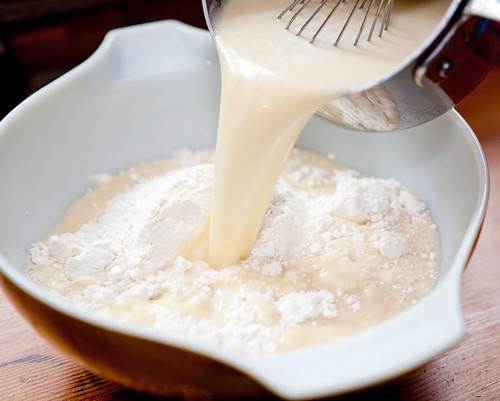
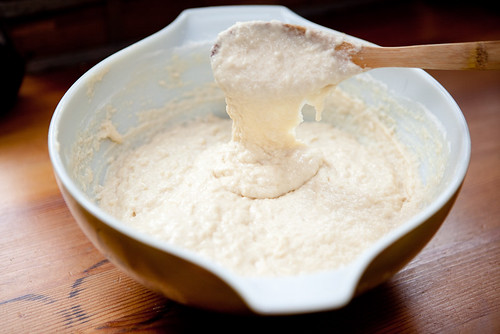
In a large bowl, combine all the above ingredients. Mix well with your hands until all the flour is absorbed and a sticky, wet dough has formed. At this point, decide if you’re going to knead by hand or with a stand mixer. While I love kneading by hand, I used a stand mixer. This dough is very soft and sticky, and I don’t use my kitchenaid enough.
By Hand
Dip a metal spoon in cold water and beat the dough with it, re-cooling the spoon as you go. While beating the dough, spin the bowl in the opposite direction with your free hand. Reverse the spin every-so-often. “Knead” the dough in this fashion for 5-7 minutes, until a smooth but still very sticky mass has formed.
Stand Mixer - My preferred method
Using the dough hook, beat the dough for 5-7 minutes on a medium speed, or until a smooth, sticky mass has formed. While the dough is being kneaded, it should look like a tornado; it should clear the sides of the bowl, but still be attached to the bottom of it, forming a dough tornado up the dough hook. If the dough is still sticking to the sides of the bowl, add flour, little by little, until the sides release. If the dough isn’t sticking to the bottom of the bowl, add water, little by little, until it does.

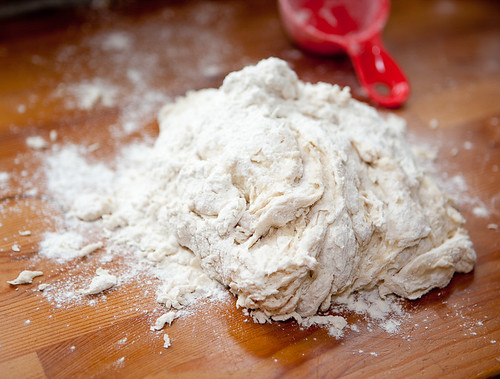
Scrape the dough out onto a well-floured surface.

With a wet chef’s knife, cut the dough into 6 equal hunks. Each hunk should weigh 6 oz, if you’re anal like that. Generously dust the dough with flour.

Flour your hands well and gently shape each hunk into a sphere. If the dough is sticking to you or anything else, use more flour.

At this point, prepare any dough you want to freeze for later. In a small bowl, add a few tablespoons of olive oil. Roll the dough ball in the oil and place in a freezer bag - one ball per bag. Freeze immediately for up to three months. The day before you want to make pizza from the frozen dough, remove it from the freezer and into the refrigerator to defrost overnight.

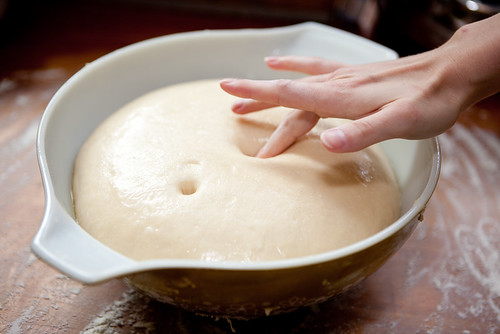
The dough you’re going to use within in the next three days should be placed on parchment paper, covered in oil, and wrapped with plastic wrap. Let dough rest in the refrigerator overnight, or for up to three days.
Through the magic of the internet, time passes immediately

Two hours before making the pizza, remove the dough from the refrigerator and let it sit on the counter at room temperature. 45 minutes before making the pizza, pre-heat the oven with the pizza stone in the bottom (or on the lowest rack) to 450-500º F.

Press dough, still on the parchment paper, into a disc. Remove the plastic wrap and dust liberally with flour.

Gently press the dough out, enlarging it into 9″ - 12″ in diameter. My dough was really soft, so pressing sufficed. If your dough is firmer, you can try picking it up and spreading it over your knuckles, or just using a rolling pin.

Now for a fun trick. I’ve always had trouble getting soft, uncooked pizza dough onto a peel (or the back of a cookie sheet) and into the oven without destroying the pizza. Here’s how I’ve learned to do it successfully. Dust the top of the dough (which will soon be the bottom) with cornmeal.

Place the peel over the top of the dough.

Flip the dough over, so the bottom of the dough that was coated in cornmeal is now laying on the peel. Give the peel a little shake, the dough should slide freely! If it does, you’re in luck.
Top your pizza mosdestly - 3-4 toppings including sauce! We like to top our pizzas with tomato sauce, sundried tomatoes, pineapple chunks, and pine nuts.
Check to be sure your pizza still slides easily on your peel. If it does, gently slide the pizza off the peel onto the hot stone with small but firm jerks of your arm. Bake at 450º for 5-8 minutes, until crust is lightly browned around the edges.
Top with freshly chopped herbs and a drizzle of olive oil. Enjoy!

December 28th, 2007

I’ve wanted to make stuffed artichokes for a long time, but the idea of prepping artichokes always gave me a dull headache. My mom used to make them all the time when I was younger, simply steamed with some melted butter. We’d fend for ourselves once we got to the artichoke heart, covered in spiky fuzz (the choke), a clear reminder that we were really eating an overgrown thistle.
But when you stuff artichokes, it’s usually best to remove the nasty choke ahead of time to make room for stuffing, which also makes eating the artichoke a little less complicated. That way, when you get to the heart you can dig right in without getting a mouthful of fuzz.
If you’ve never eaten a whole artichoke before, let me implore you to try it, and to not eat the leaves. Well, that’s not entirely right. You eat part of each leaf, scraping off the flashy bit at the base with your bottom teeth. Or your top teeth. Just make sure you don’t pop a whole leaf in your mouth. Set an empty bowl on the table to collect the spent leaves.
The leaves start off with only a little of the good stuff on the bottom. The artichoke may seem like a tease, giving you only tiny tantalizing morsels at first, but I promise you; this is one vegetable that puts out in the end, every time. The closer you get to the center, the more edible the leaves become. You’re finally rewarded with the heart of the artichoke, and what a delicious treat that is. It’s well-worth messily eating your way towards it.
But before you can eat it, you need to prep it. There are two things you need to know, right off the bat. The first is that artichokes oxidize, turning color once the cut edges are exposed to air, much like apples and potatoes do. Keep a cut lemon nearby and rub the exposed edges of the ‘choke with it to prevent this. The second thing to remember is to keep the ‘chokes away from anything made of aluminum of iron - this will also cause the artichoke discolor. Use stainless steel knives and cookware, or anything else that’s non-reactive, such as glass. Ready?

Remove the bottom few rows of leaves with a knife. These are the toughest and can be discarded.

Remove the stem of the artichoke, so it can stand upright. Rub the bottom with lemon juice.

Slice the top inch or so off. It’s okay if it’s not perfectly flat.

Rub lemon on the cut edges to prevent discoloration.

Cut the tips off any leaves that still have their points. They have sharp bits on the end that you want to remove before eating.

Gently spread the leaves apart with your fingers to expose the center. Sometimes the center leaves are purple as shown, but sometimes they’re just a delicate yellow.

Remove the leaves, scraping them out with a spoon. The sharper the edge, the better off you’ll be. If you have a melon baller, use that. My 1/2 teaspoon measure worked better for me than a regular spoon.

Now you should see the top of the choke, the fuzzy part you don’t want to eat. Use your spoon to scrape out the fuzzy bits out until you reach the smooth surface of the heart.
Be careful not to remove too much of the heart, as that’s the best part of the artichoke! Take your time, and be sure to sqeeze lemon juice down there while you’re working.

While you’re prepping ‘chokes, let the finished ones sit in a bowl of cold lemon water.
Stuffed Artichokes with Herbed Sundried Tomato Stuffing
For two artichokes
2 Artichokes, prepped as shown above
Stuffing
2 Cups Breadcrumbs
4-5 Tbs Fresh Chopped Herbs, I used Marjoram
1/3 Cup Chopped Sundried Tomatoes, oil packed
1/4 tsp Salt
Black Pepper, to taste
Olive Oil
Broth for Steaming
3 Cups Water
1 Vegetable Bullion Cube
3-4 Lemon Slices
1 Bay Leaf
Black Pepper
Toss all the ingredients of the stuffing together, save the olive oil. Drizzle the olive oil into the stuffing mixture until just moistened.

Fill the center cavity of each artichoke with stuffing. Use the remaining stuffing in between the leaves of each choke. Spread the stuffing out as evenly as you can, stuffing in as many leave crevices you can get into.

Place broth ingredients in the bottom of dutch oven large enough to fit the ‘chokes. Set the ‘chokes inside, making sure the broth level only covers an inch or so of the bottom of the ‘chokes. Simmer, covered, for 30-45 minutes, or until the leaves are tender and can be removed with a gentle tug.
Preheat oven to 350º, and bake the steamed chokes for 10-15 minutes until the stuffing is crispy and browned. Serve immediately.
December 5th, 2007
Previous Posts