Posts filed under 'dessert'

Lemon Maple Scones with Vegan Clotted Cream

Lemon Maple Scones with Vegan Clotted Cream

American scones are different than British scones. Up until today, when I pictured a scone in my head, it was triangular, fairly large, dry, crumbly and sweet. And tasty.

Imagine my surprise when I did a google image search and saw photo after photo of things that looked like biscuits. After some research (thank you wikipedia), I realized that British scones are indeed different than their American counterparts. They’re less sweet, smaller, and fluffier–and indeed fairly similar to the US biscuit. I had to make some. And I had to eat them with clotted cream.

Lemon Maple Scones with Vegan Clotted CreamNow, I’ve never had clotted cream. Despite the fact that it’s definitely not vegan, it’s made with unpasteurized milk which is simply unavailable in most areas–it’s actually illegal in 25 states. From what I’ve read, clotted cream is slightly sweet, has a light tang, and is at least 55% fat. It’s usually served on scones for cream tea (tea served with scones, clotted cream and jam), so I decided that I needed to make a vegan version. Like, immediately.

Usually scones are served with strawberry jam. I decided to go with fresh, organic blueberries because I had them on hand, but any fresh berry or your favorite jam will be perfect for these. They’re really quick to throw together, so it really is a nice thing to make fresh for afternoon tea or a nice weekend breakfast. They’re best served warm, but I hear you can freeze them if needed.

These scones are very lightly flavored. I love the combination of lemon and maple, but since I was trying to emulate British scones, the flavoring is delicate. They’re good on their own, but spectacular with the clotted cream and berries. Does the vegan clotted cream tase anything like the real stuff? I have no idea, but my best guess is no. But even if it’s not the same, it’s really, really tasty.

Lemon Maple Scones with Clotted Cream
Makes 12-15 2″ Scones

2 Cups All- Purpose Flour
2 1/2 tsp Baking Powder
1/2 tsp Salt
Zest of 1 Lemon
1/3 Cup Earth Balance Margarine
3 Tbs Maple Syrup (or regular sugar)
1/2 Cup Soymilk
2 Tbs Lemon Juice

Clotted Cream
4 Tbs Earth Balance Margarine
4 Tbs Tofutti Better Than Cream Cheese
2 Tbs Powdered Sugar

Whisk the ingredients for the clotted cream together. It takes some elbow grease, but it will soon be a thick, smooth cream. Let it sit out to soften a little if needed to ease mixing. Set aside at room temperature; refrigerating will make the cream stiffer.

Preheat oven to 400º F.

Whisk all the dry ingredients together in a mixing bowl (flour through zest). Mix the wet ingredients together (syrup, soymilk and lemon juice). Using a pastry cutter or a fork, blend the Earth Balance into the dry ingredients until there are no chunks of margarine left and the mixture looks like damp sand.

Pour in the wet ingredients and mix with your hands to form a soft dough. Only mix until just combined, adding more flour if the mixture is too wet. Turn out the dough onto a floured surface and roll out to a slab 3/4″ thick. Using a biscuit cutter or a glass with about a 2″ diameter, cut out your scones. Press the scraps of dough together, roll out again, and continue cutting scones until you’ve used up your dough.

Cutting Scones

Transfer scones to a cookie sheet covered in parchment paper, or a non-stick mat. Brush the tops with a mixture of soymilk, powdered sugar and lemon juice.

Soymilk Wash for Scones

Bake at 400º F for 12-15 minutes. If the scones aren’t lightly brown after 15 minutes, transfer to the broiler for 1-2 minutes, watching carefully, to brown the tops if desired. Remove to a cooling rack.

While still warm, split and slather each side with clotted cream. Add berries or jam to the top and serve with your favorite tea.

Lemon Maple Scones with Vegan Clotted Cream

44 comments March 20th, 2008

Mini Coconut Blood Orange Bundt Cakes

Coconut Blood Orange Bundt Cakes

Happy Valentine’s day!

My husband and I don’t usually do anything for Valentine’s day, but I hardly need an excuse to whip up something pink and pretty. These little cakes are made up of rich coconut cream and a little fresh blood orange juice. You can dip hot cakes into a blood orange syrup, or reduce the syrup and drizzle it over the cakes for serving. Fresh blood orange segments, supremed, compliment the sweet cakes perfectly. And hey, they’re pretty.

Blood OrangesBlood oranges are the perfect fruit for winter desserts. Why use strawberries (or what are labeled strawberries in February in Boston), when you can use fresh, organic, blood oranges which happen to be in season right now? You can use regular oranges for this recipe as well, but blood oranges are just so gosh darn pretty.

The gorgeous color of the segments transfers easily to the syrup–so rich and crisp, a perfect, deep pink that’s perfect for Valentine’s day, don’t you think? The color inside a blood orange ranges from standard orange to dark red, sometimes you can even find both colors within one orange. The color inside is dependent upon light, temperature and variety. They usually look like regular oranges on the outside, but sometimes you can see a red blush creeping over the rind that tips you off.

Mini Coconut Blood Orange Bundt Cakes
Makes six mini (1 Cup) bundt cakes (photo)

1 1/2 Cups Flour
3/4 Cups Sugar
2 1/4 tsp Baking Powder
1/4 tsp Salt
1/3 Cup Coconut Cream*
2 Tbs Blood Orange Juice (or regular orange)
3/4 Cup Soy Milk
2 Tbs Water
1-2 tsp Vanilla Extract

*In warm weather, refrigerate a can of coconut milk until the cream floats to the top and solidifies. In cold weather, I just take it out of my pantry and it’s ready to go. Here’s a photo.

Preheat oven to 400º F. Grease a mini bundt cake pan.Whisk dry ingredients together. Whisk wet ingredients together in a separate bowl. Gently fold wet ingredients into dry until just combined. Fill each cup with 1/2 Cup of batter. Bake for 25-30 minutes, or until lightly browned on top. See below for soaking the cakes in syrup. Let cool for 10 minutes before removing from the pan. Let cool under plastic wrap to keep the outsides nice and soft.

So how about that blood orange syrup?

Juicing Blood Oranges

Blood Orange SyrupBlood Orange Syrup
Makes about 1 Cup

1/2 Cup Sugar
1/2 Cup Water
1/4 Cup Blood Orange Juice, strained

Combine sugar and water boil until sugar is dissolved. Remove from heat and stir in juice. To make a thicker syrup, boil again until the sugar begins to expand greatly in volume (230º F, thread stage) then remove from heat.

You can re-heat it if needed before decorating the plates or the cakes.

You can soak the cakes in the thin version of the syrup for a moister cake. As soon as the cakes come out of the oven, poke them with a fork and pour 1/2 of the syrup evenly over the tops. Let sit for at least 10 minutes before unmolding. You can then thicken the leftover syrup for decoration.

Soaking Bundt Cakes with Blood Orange Syrup

Hope you have a sweet day!

Cococnut and Blood Orange Bundt Cakes

36 comments February 13th, 2008

Brown Sugar and Peach Muffins (spelt challenge!)

Brown Sugar and Peach Muffins

I have to admit, I’m not an equal opportunity flour employer. I reach for wheat without a thought, except for perhaps whether I want to use high gluten, all purpose, whole wheat, or pastry flour. A few days ago, however, I got a really fun package from Celine of Have Cake, Will Travel (one of my favorite food blogs, by the way). She generously gave me a bunch of fun flours/startches from Bob’s Red Mill, and included was a bag of light spelt.

Let me be the first to point out that spelt is wheat. It’s not a huge step out into unknown territory, but it is a start. I’m treating spelt like training wheels before I graduate to other types of grain and bean flours. Because spelt is wheat, I figured it’d be a good candidate for a head-to-head comparison. Gluten-free flours (which spelt is most definitely not) are usually best in combination with other GF flours, so it’s difficult to compare them to wheat in the same way. It can be hard to tell what you’re tasting. With spelt, I could substitute 1:1 without additional ingredients. For the purposes of this post, I’ll refer to spelt as spelt, and wheat as wheat, even though spelt is just as much wheat as wheat is. (It hurt my brain to write that sentence, but it was necessary.)

I thought it’d be fun to make two identical batches of muffins, with one major difference. One batch is 100% All Purpose Wheat (King Arthur), and the other 100% Light Spelt (Bob’s Red Mill). That way I’d be able to see exactly how spelt behaves and tastes in a relatively unchallenging, easy to duplicate recipe. The results, my friends, were surprising. Here’s the recipe:

Brown Sugar and Peach Muffins
Makes 12 Muffins

2 Cups Flour (spelt or all-purpose wheat)
1/2 Cup Brown Sugar*
2 tsp Baking Powder
1 tsp Baking Soda
1/4 tsp Salt
1 Cup Soymilk (+ 2 Tbs more for all-purpose flour)
1 Tbs Lemon Juice
1/3 Cup Oil (like canola)
1 tsp Vanilla Extract
1/2 – 2/3 Cup Peaches, chopped (fresh or canned)
Extra Brown Sugar, for sanding

Preheat oven to 400º F.

Line your muffin tins with muffin cups. Mix the dry ingredients together.

Molasses and Sugar *If needed, you can make your own brown sugar by adding 1/2 – 1 tsp of molasses to 1/2 cup of sugar and mixing well. It takes a little while to mix completely, but you can make it as light or as dark as you wish. It’s my understanding that commercial brown sugar is made by mixing molasses back in to processed sugar, so it’s really not any different than store-bought.

Whisk the wet ingredients together until incorporated and thickened. Add wet to dry and gently fold the until the flour is moistened and there are no dry spots. Add the chopped peaches and fold in gently.

Fill muffin cups 3/4 of the way. Sprinkle with extra brown sugar, and add extra peach pieces on top if desired. Bake for 18-22 minutes, or until lightly browned and a toothpick comes out clean. The centers should also bounce back when pressed lightly.

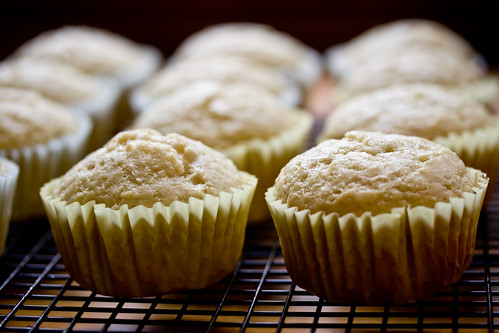
First off, let’s get appearances out of the way.

Light Spelt vs. All Purpose Wheat

The one you’re guessing is spelt–the squatty, sad looking one–is indeed spelt. Check out the difference from another angle, wrapper removed:

Light Spelt vs. All Purpose Wheat

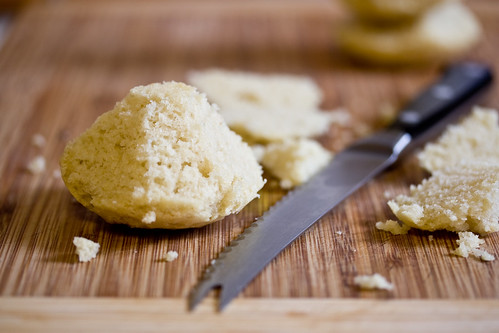
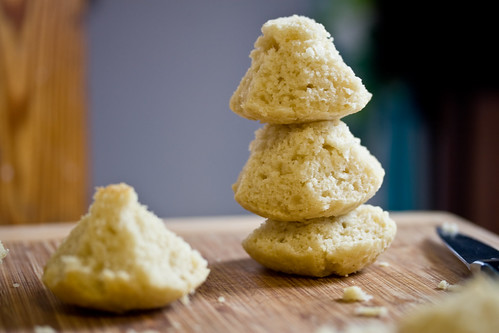
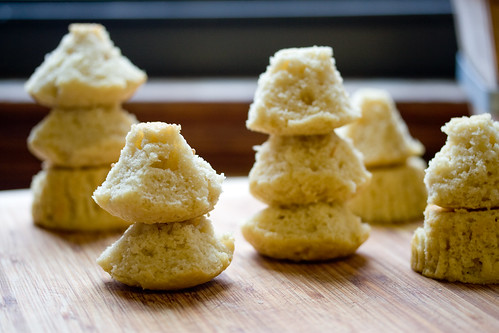
Want to see the insides? Okay:

Light Spelt vs. All Purpose Wheat

In general, the spelt muffins were darker, flatter, and more moist than the wheat muffins. I think the rising issue can be resolved, or at least improved. The spelt batter was a lot wetter than the wheat batter. It’s possible I accidently added too much liquid, but it seemed that the wheat was more absorbent than the spelt. I think the wetter batter contributed to the spelt muffins not rising as much as the wheat. More on that in a second.

If I were truly dedicated I would have made a third, dryer spelt batch to test my theory, but two dozen muffins is plenty for my husband and me. If I made three dozen we’d still eat them all, which is why it’s really important for me not to make them. Next time, I’ll shoot for a light and airy batter that’s just barely thick enough to hold air bubbles, instead of a drippy, pancake-like batter.

Light Spelt vs. All Purpose WheatBut what about taste?

If I saw these two muffins sitting out, I’d grab a wheat muffin. They just look better, don’t they? But after tasting both muffins, I have to say that the spelt muffins weren’t just good, they were superior.

The spelt tasted better!

I went into this test fairly prejudiced. I was expecting to report to you all that the spelt tasted “fine, but wheat is definitely better.” Several back-to-back bites confirmed my initial decision. The spelt is definitely better. The spelt muffins taste richer, almost buttery. The wheat muffins taste good on their own, but when compared directly with the spelt, their flavor is flat and sponge-like. I was really expecting the spelt to taste “off” – not bad, but different enough to make my wheat-tuned palate complain. I’ll have to use spelt in some other recipes to confirm, but in this recipe it’s the clear winner when it come to taste.

Light Spelt vs. All Purpose WheatBut back to the less-than-spectacular appearance of the spelt muffins. The crumb of the spelt was definitely more delicate than the wheat – the muffins fall apart with only the slightest coaxing.

The gluten present in spelt is more delicate than in regular wheat; overmixing, undermixing, too much or too little liquid–all these can cause a less-than-spectacular finished product. If you hit the sweet spot, the gluten develops enough to hold in gasses that provide a beautifully risen product. Too much mixing (or kneading if you’re making bread) can break the gluten, not enough prevents it from forming at all. With these muffins, I think the batter was so wet that it became too heavy for the delicate nature of spelt, preventing prettily puffed muffins.

I’m surprised that I actually prefer the taste of spelt over regular wheat. You should try it, you might too! Also, I could be crazy, but it smells a little like popcorn when it’s baking. Fun!

Special thanks to Celine for broadening my grain horizons.

Brown Sugar and Peach Muffins

57 comments February 1st, 2008

The Search For Vegan Madeleines

Madeleines and Tea and Knitting

The short version of this post: I don’t have a perfect vegan madeleine recipe, yet. But if you want to experiment for yourself, these notes might be helpful. For those of you who are interested, here’s the long version:

In my last post I talked about petits fours, specifically petits fours glacés–meaning iced. I mentioned how the term petit four can refer to many kinds of small sweets. As soon as my blood sugar returned to normal human levels, I began working on petits fours secs, specifically madeleines.

Even if you’ve forgotten the French you learned in highschool (goodness knows I have), you’re probably already familar with the word sec, as in triple sec. The world sec is often used to describe a lack of sweetness in an alcoholic beverage, but in the case of triple sec it means that the alcohol has been distilled three times, i.e. triple dry. What does this have to do with petits fours? Nothing, really. Just remember that sec means “dry.”

#3 MadeleinesA common petit four sec is a madeleine – a lemony shell-shaped confection that hovers somewhere between cookies, cakes, and shortbreads. There is much discussion about what the original madeleines, the ones eaten and written about by Proust, were really like. Softy and crumby? Dry and sconelike? It seems that most people seem to prize the following characteristics of madeleines, so these are my goals for my final version:

1. Crispy and browned around the edges
2. Softish in the middle
3. Well defined, smooth shell ridges on one side
4. A nice “hump” on the other side
5. Slightly sweet and lemony, with buttery undertones

All recipes I’ve found seem to call for the liberal use of eggs, which are beaten with sugar to the “ribbon stage” before completing the batter. Obviously eggs are out of the question, so I’m experimenting with egg replacers and chemical leavening, but we’ll get into that in a minute.

The first thing I do when trying to create a vegan recipe is study as many non-vegan recipes on the web as I can. After getting a feel for the standard recipes in use, I usually pick the recipe that seems to be the easiest to veganize and substitute non-vegan ingredients with the vegan versions. Then I take stock of the results and change what needs to be changed, if anything.

For the madeleines, I decided to veganize a recipe I found on about.com. It only called for two eggs (as opposed the three or four that some other recipes used), and it only made 12 – I wouldn’t be stuck with three dozen if they didn’t turn out.

Madeleines – Trial One (Unphotographed)

1 1/4 cup flour (I used Pastry Flour)
1 tsp baking powder
2 eggs Ener-G Eggs
1/2 cup icing sugar
1 tbs lemon or orange juice
6 tbs butter Earth Balance Margarine, melted
Grated rind of lemon or orange

Melt margarine and let cool. Mix dry ingredients together. Beat ener-g eggs and sugar together until frothy. Add juice and zest to the ener-g mixture. Alternately beat in dry ingredients and melted earth balance until all combined. Grease and flour a madeleine pan and fill each shell 2/3 full with batter. Bake at 375º until crisp and brown around the edges (15-20 minutes).

#1 Results: Too scone-like, a little ugly, tastes okay
1. They were crispy and browned
2. They were a little dry in the middle, but not bad
3. The ridges were undefined because of poor pan flouring (see photo)
4. No hump
5. Correct sweetness and buttery undertones (for my taste)

Too Much Oil

If you put to much oil on your pan, the flour sticks too well and actually fills in the ridges a little, making for lame looking madeleines. This is how the pan will look after it’s been properly floured. Use a cooking spray to oil your pan, and hold the pan a good two feet away from the nozzle. You want an even, light coating of oil which will ensure an even, light coating of flour. Like so:

Properly Dusted Pan

Madeleines – Trial Two

I wanted to see if I could increase the moisture content, so I tried out a modified version of a lemon muffin recipe of mine. I increased the heat to 400º help brown the edges and create a peaked hump.

1 Cup All Purpose Flour
2 Tbs Sugar
1 tsp Baking Powder
1/2 tsp Baking Soda
1 Pinch Salt
1/2 Cup Soy Milk
1 Tbs Lemon Juice and Zest from the lemon
3 Tbs Vegetable Oil
1 tsp Vanilla Extract

Try #2, Batter too thick

Whisk dry ingredients together. Whisk soy milk, juice, zest, oil and extract together until thickened. Fold the wet ingredients into the dry. Bake in an oiled and floured madeleine pan for 15 minutes. Remove and let cool on a rack shell-side up.

#2 Results: Total disaster
1. They didn’t brown
2. Too soft in the middle
3. No ridges, batter way too thick and bubbly
4. No hump
5. Not sweet enough

These were a disaster. It seemed I was better off with the first recipe. The batter was way too thick, creating a lot of textural and aesthetic problems. I decided to thin out the batter used above by adding 1/4 cup of water just to see what would happen:

Madeleines – Trial Three

Same recipes as #2 but with 1/4 cup added water.

Try #3, better

#2 vs. #3 - The Choice is Clear

You can see trial #2 madeleines on the left, and #3 on the right. I wanted to show you how a simple thing like batter consistency can have a HUGE effect of the final result. The third batch certainly looked better, by about a hundred billion times. But how did they stack up?

#3 Results: Pretty, but that’s about it.
1. Beautifully browned
2. Texture all wrong, too much like cupcakes
3. Beautiful Ridges
4. Humps!
5. Not sweet enough

Madeleines

So after all that, I’m still searching for the perfect madeleines. It wasn’t until after my third try that I realized I might have had the answer all along in my petits fours glacés – the cake had these beautifully crispy and caramelized edges. If I can combine those edges with a less cake-like texture I’ll be in business. I’ll let you know the final recipe, if I ever find it…..

Madeleines and Tea and Knitting

38 comments January 18th, 2008

Petits Fours

Petits Fours

If you’ve been keeping up with my blog for a while, you know that I like all things miniature. Especially desserts. I’m surprised it’s taken me this long to make petits fours. They’re the perfect mini dessert; a tiny layer cake, dipped in poured fondant and individually decorated. Bite sized individual cakes? Yes, please. Who on earth could say no to these?

Sometimes people use the term petit four generally. They might be referring to any small dessert, even a simple piece of chocolate. The majority of the time, however, they are referring to these fancy miniature iced cakes. They’re typically cube-shaped, though you’ll sometimes see diamonds, rectangles, and cylinders. The iced versions are technically called petits fours glacés, but rarely to people get so specific.

You can just dip a cube of cake into icing and call it a day (or rather a petit four), but the most traditional versions are layered with jam, soaked with liquor syrup, dipped in poured fondant and decorated. Pain in the ass? Yes. Worth it? Hell yes.

Petits FoursLet’s talk for a minute about the components of this type of petit four. The cake is typically a génoise, which is a French cake named after a city in Italy. Génoise cakes traditionally do not include any chemical leavening all, but instead trap air in the batter by vigorous beating before baking. In normal génoise recipes, eggs help to keep the air in the batter. In the oven, the heated air expands and causes the cake to rise. This recipe contains no eggs, however, so chemical leavening is used. I used Bryanna Clark Grogan’s recipe, but any fairly dense cake recipe (like a pound cake) will work for this. A tight crumb will make your life easier when slicing the petits fours. Make sure to visit Bryanna’s page, though; she has wonderful tips on making fancy vegan cakes, a nice buttercream recipe, and lots of photos.

I iced my petits fours with poured fondant. There are two types of fondant, rolled and poured. Before I started researching for this, I only knew of rolled fondant, which is the really neat sugar-dough stuff that is often used to decorate wedding cakes. Poured fondant is similar to rolled, but instead of rolling it out to use it, you pour it while it’s in a liquified state. Makes sense to me. It’s easy to make, but it does require a candy thermometer. You need to boil sugar, corn syrup and water until the soft ball stage, but we’ll get to that later.

Once you have the cake and the fondant figured out, give yourself a break and buy a jam, any jam, for the filling. Sure, you can pick berries and make your own filling, but store-bought jam works beautifully in this and saves you a step or five. You can also soak the cake with a liquor syrup if desired. I never do this for my cakes, but if you want to, use a ration of 1:1:1 water, sugar, liquor. In a saucepan, dissolve sugar completely in the water. Remove from heat, add liquor, and allow to cool.

Now you’ll also need a few tools. A candy thermometer ($10 for a standard one, $30 for an electric one that has programs and alarms and such), a jelly roll pan (aka cookie sheet with sides), a food processor, a large serrated knife, parchment paper, a rolling pin, and a cooling rack.

Right. Are you ready?

Petits Fours
Makes 30 1 1/2″ Pieces

1 Cake recipe, below
1 Fondant Recipe, below
1 1/2 Cups Jam, warmed (raspberry is nice!)
1/2 Cup Marzipan
Powdered Sugar, for rolling out marzipan
Melted Chocolate, for decoration, optional

Bryanna Clark Grogan’s Génoise
Makes 5 Cups of Batter

2 1/2 Cups plus 2 T. pastry or cake flour
1 1/2 Cups Granulated Sugar
2 tsp Baking Powder
1/2 tsp Baking Soda
3/4 tsp Salt
1/4 Cup plus 2 Tbs Earth Balance
2 Tbs Fresh Lemon Juice and Zest of 1 whole Lemon
1 Cup Water
3/4 Cup Soy or Rice Milk
1 1/2 tsp Vanilla Extract
1 tsp Pure Lemon Extract

Preheat oven to 350º F.

Brush a Jelly Roll Pan (half sheet size, 12 x 17 x 1″) with oil. Use two sheets of parchment paper to cover the bottom, overlapping each long edge of the pan. This will allow you to lift the entire cake out of the pan without breaking it. The oil helps the parchment stick to the pan, so it doesn’t slip while pouring in the batter.

Mix the dry ingredients together in a large bowl. Add Earth Balance, water, and lemon juice and beat well (with an electric mixer if available) for about a minute. Add the remaining ingredients and beat again. Pour the batter into the lined jelly roll pan and bake for 25-30 minutes, until the edges are golden brown and the top is lightly browned, and the center springs back to your touch. Allow to cool in pan until just warm.

Génoise Out of the Oven

Gripping the parchment in the center on either side, gently lift the cake out of the pan and place it on a large cutting surface. It should look like this:

Génoise Removed from Jelly Roll Pan

With a serrated knife, cut off all the caramelized edges (eat them!), and quarter the cake. Below is a photo of one of the four trimmed quarters:

Trimming the Génoise

Alright, here’s the first tricky part. With a large serrated knife, cut each quarter in half horizontally. You can take as much time as you need. Cut a little bit at a time, making sure your knife is being held level. Ideally you want two even layers.

Slicing the Génoise

Carefully separate the layers. You should now have this:

Génoise Slices

Spread the warmed jam on one of the sliced cake quarters. You don’t need a ton of jam, just enough to color the cake. You should still be able to see the cake through the jam.

Spreading the Jam

Begin stacking, alternating cake and jam, until you have four layers of cake. You should have enough cake to make two stacks, each stack containing four layers of cake and three layers of jam. Trim the edges if needed.

Divide the marzipan in half. Knead it until it softens, then roll each chunk out separately using powdered sugar to prevent it from sticking.

Marzipan

Roll it out until you get a thin, even sheet that is larger in all directions than your layered cake.

Marzipan Sheet

Brush one side of the marzipan with water to make it sticky, then place it on top of your cake, sticky-side down. Trim the edges off with scissors. Repeat for the second rectangle of cake.

Ready to be refrigerated

The cake is now ready to be refrigerated. It should be approximately 1 1/2 inches high. Cover it in plastic wrap and refrigerate for several hours or overnight; this helps the jam set up and will help the cake stay together when you cut it into petit fours.

Layered Génoise Measures 1 1/2 Inches

Now the cake has been refrigerated overnight!

Using a ruler, score the marzipan with 1 1/2 inch grid as a cutting guideline. Each rectangle of cake should have 15 full squares, and a little extra that you can cut off and eat. Here’s the scored, trimmed cake:

Score the Marzipan

Keeping your knife as straight as possible, use long, sawing strokes to cut the cubes. Cover with plastic wrap to prevent the cake from drying out.

Cut Petits Fours

Prepare your fondant:
Helen Fletcher’s Poured Fondant

2 1/2 Cups Sugar
1/2 Cup Water
1/4 Cup Corn Syrup

Written directions copy and pasted directly:
Poured Fondant, coolingHeat sugar, water and corn syrup to the soft-ball stage (238°F; 114°C). Pour into the food processor fitted with the steel blade. Wash the candy thermometer well and reinsert into the syrup. Let the syrup cool undisturbed in the workbowl to 140°F (60°C), about 30 minutes. Remove the thermometer.

Add any coloring or flavoring (vanilla, almond extract, etc.) and process 2 to 3 minutes, until the syrup completely converts from a glassy syrup to an opaque paste. When thoroughly cooled, store sealed at room temperature for 24 hours. Use or refrigerate for later use. [I just want to add: It will harden once completely cooled, simply microwave to liquify. It is warm enough to use for the petits fours immediately after processing.]

Poured Fondant, mid-processPoured Fondant Complete

Place your petits fours on a cooling rack and pour your fondant into a small bowl. You’re ready to ice them!

Petits Fours ready for Icing

In my opinion, icing is the hardest part. You need to keep your fondant warm and melty, and you’ll notice that it starts to set up fast. Give it a stir with a spoon before you dip each piece, as this will break any skin that has formed on top of the fondant. If it gets too thick (thinner is better), pop it in the microwave for 30 seconds and try again.

Start with the ugly ones, that way if you mess up on the first few you won’t be as sad. Hold each cube so your forefinger is on the top of the cake (touching the marzipan) and your thumb is on the bottom. Dip all four sides.

Icing Petits Fours

Place the dipped petit four on the rack. Use a spoon to ice the top.

Icing Petits Fours

Let the petits fours set. You may need the help of a sharp knife to remove them from the rack once the fondant is hardened. I drizzled some melted chocolate over them to decorate, but you can decorate them anyway you want. Piped buttercream, molded marzipan, whatever makes you happy.

Petits Fours

137 comments January 8th, 2008

Next Posts Previous Posts


Get the VYY book!

VYY on your iPhone

Click for the FREE app.

Knit Night Cupcakes

Knit Night Cupcakes - Yarn Balls If you're looking for the Knit Night Cupcakes that were featured on the Martha Stewart Show, the original post is here!

Email me at lolo AT veganyumyum DOT com

Fun Stuff

  • VeganYumYum Reader Flickr Pool
  • My Amazon.com Wish List
  • Calendar

    September 2010
    M T W T F S S
    « Jan    
     12345
    6789101112
    13141516171819
    20212223242526
    27282930  

    Posts by Month

    Posts by Category