Posts filed under 'dessert'

Even if you don’t know what a tuile cookie is (pronounced “twill” or “tweel”), you’ve probably eaten them before. They’re delicate and sweet and often stuck into desserts, especially ice cream, at fancy restaurants. The great thing about tuile cookies is that they come out of the oven soft and pliable, allowing you to shape them whatever way you want before they cool and harden. They’re crisp and sweet and buttery–like the most delicate, most delicious ice cream cone you’ve ever had. In fact, ice cream cones are what got me thinking of tuile.
It’s 80 degrees here today, so I started thinking about making some ice cream. Then I thought about making my own ice cream cones. Then I thought about tuiles. And since there doesn’t seem to be a recipe for vegan tuile cookies on the internet, I decided to make up my own. And it worked! Perfectly. (I know, I’m just as shocked as you are. Apparently you really can learn how to make fancy things just by watching a lot of cooking shows on tv. My sister and I used to come home from school watch Great Chefs on PBS before the Food Network ever existed. Remember that show? I’m pretty sure that’s where I learned about tuile.)
So anyway. Tuile cookies aren’t hard, but they do require a few tools, some concentration, and the willingness to lightly burn your fingers. Since I don’t mind sacrificing myself for cookies, this wasn’t a problem for me. Just be forewarned. Here’s what you’ll need to make them:
- A silpat, or non-stick mat, or waxed parchment paper
- An offset spatula
- A clean piece of cardboard (not super thick) or tuile template
- Molds (bowl, rolled paper, whatever)
Let’s get to the recipe, I’ll explain in more detail as I go.
Vegan Tuile Cookies
Makes 1-2 dozen depending on size
1/2 Cup Earth Balance, softened
1/2 Cup Sugar
2 Tbs Flax Egg*
1 tsp Vanilla
1/4 tsp Salt
3/4 Cup All-Purpose Flour
Flax Egg
1 Tbs Flax Seed
1/4 Cup Water
Grind the flax seed to a powder in a spice grinder. Whisk with water and set aside. Use 2 Tbs of this mixture for the tuile cookies, you’ll have a little left over
Preheat oven to 375°F.

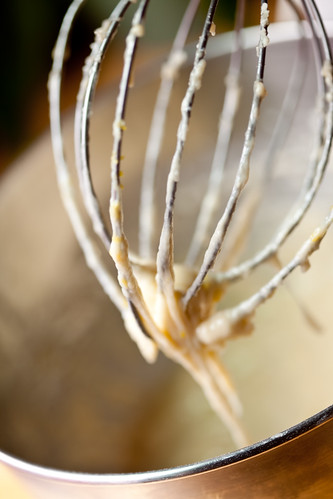
Whip the Earth Balance and sugar until light and fluffy, so it looks like the photo above. Once the Earth Balance is soft enough it should whip up just fine.

Add flax egg, extract, and salt. Whip until you see medium to stiff peaks like above. Gently fold in flour and mix until well combined. Your batter is ready, so prepare your workstation.
You can buy specialized tuile templates in lots of different shapes, but a piece of clean cardboard works just as well. I traced a glass and cut the circle out with an x-acto knife for my template. You can do circles, squares, rectangles, flowers, stars - anything!

Put your template down on your silpat and add a glob of batter. Using your offset spatula, carefully spread the batter out to fill the template, remove the excess batter.

Lift the template up to remove it. You’re cookies are ready to go in the oven. Bake the cookies for 8-10 minutes or until edges are golden brown. You may need to experiment with baking time to reach the ideal balance between strength and pliability.
I recommend not making more than 2-3 cookies at a time. You’ll need to shape them immediately after they come out of the oven, and since they harden quickly, it’s difficult to shape more than 2 or 3 in one go.
It’s also important to completely cool the baking sheet between each batch. Dump the hot baking sheet in the sink and spray it down with cold water. Dry thoroughly before the next batch.
When they come out of the oven, let them sit on the cookie sheet for 15-30 seconds. Gently remove them with a spatula and shape them immediately (this is the part where you might burn your fingers). You can make all sorts of shapes. If your template was circular, here are some ways you can shape them. I’m in the process of forming bowls in this picture, and I had already made cones, cylinders, and tacos.

I used regular paper, rolled into cylinders and cones and taped, to make the other shapes. Once cool the shape will set.
Now you can use them whichever way you want! I filled mine with almond soy pudding and fresh strawberries. You can add them to ice cream, fill them with vegan pastry cream, stuff them with berries or custard, dip them in chocolate–whatever. If you want to make the cookies ahead, I recommend not filling them until the last minute to prevent the cookies from getting soggy.
And I haven’t forgotten about ice cream. I actually bought an ice cream machine today, so I’ll post a recipe for vegan ice cream in the future, now that I know how to make the cones!

April 23rd, 2008

American scones are different than British scones. Up until today, when I pictured a scone in my head, it was triangular, fairly large, dry, crumbly and sweet. And tasty.
Imagine my surprise when I did a google image search and saw photo after photo of things that looked like biscuits. After some research (thank you wikipedia), I realized that British scones are indeed different than their American counterparts. They’re less sweet, smaller, and fluffier–and indeed fairly similar to the US biscuit. I had to make some. And I had to eat them with clotted cream.
Now, I’ve never had clotted cream. Despite the fact that it’s definitely not vegan, it’s made with unpasteurized milk which is simply unavailable in most areas–it’s actually illegal in 25 states. From what I’ve read, clotted cream is slightly sweet, has a light tang, and is at least 55% fat. It’s usually served on scones for cream tea (tea served with scones, clotted cream and jam), so I decided that I needed to make a vegan version. Like, immediately.
Usually scones are served with strawberry jam. I decided to go with fresh, organic blueberries because I had them on hand, but any fresh berry or your favorite jam will be perfect for these. They’re really quick to throw together, so it really is a nice thing to make fresh for afternoon tea or a nice weekend breakfast. They’re best served warm, but I hear you can freeze them if needed.
These scones are very lightly flavored. I love the combination of lemon and maple, but since I was trying to emulate British scones, the flavoring is delicate. They’re good on their own, but spectacular with the clotted cream and berries. Does the vegan clotted cream tase anything like the real stuff? I have no idea, but my best guess is no. But even if it’s not the same, it’s really, really tasty.
Lemon Maple Scones with Clotted Cream
Makes 12-15 2″ Scones
2 Cups All- Purpose Flour
2 1/2 tsp Baking Powder
1/2 tsp Salt
Zest of 1 Lemon
1/3 Cup Earth Balance Margarine
3 Tbs Maple Syrup (or regular sugar)
1/2 Cup Soymilk
2 Tbs Lemon Juice
Clotted Cream
4 Tbs Earth Balance Margarine
4 Tbs Tofutti Better Than Cream Cheese
2 Tbs Powdered Sugar
Whisk the ingredients for the clotted cream together. It takes some elbow grease, but it will soon be a thick, smooth cream. Let it sit out to soften a little if needed to ease mixing. Set aside at room temperature; refrigerating will make the cream stiffer.
Preheat oven to 400º F.
Whisk all the dry ingredients together in a mixing bowl (flour through zest). Mix the wet ingredients together (syrup, soymilk and lemon juice). Using a pastry cutter or a fork, blend the Earth Balance into the dry ingredients until there are no chunks of margarine left and the mixture looks like damp sand.
Pour in the wet ingredients and mix with your hands to form a soft dough. Only mix until just combined, adding more flour if the mixture is too wet. Turn out the dough onto a floured surface and roll out to a slab 3/4″ thick. Using a biscuit cutter or a glass with about a 2″ diameter, cut out your scones. Press the scraps of dough together, roll out again, and continue cutting scones until you’ve used up your dough.

Transfer scones to a cookie sheet covered in parchment paper, or a non-stick mat. Brush the tops with a mixture of soymilk, powdered sugar and lemon juice.

Bake at 400º F for 12-15 minutes. If the scones aren’t lightly brown after 15 minutes, transfer to the broiler for 1-2 minutes, watching carefully, to brown the tops if desired. Remove to a cooling rack.
While still warm, split and slather each side with clotted cream. Add berries or jam to the top and serve with your favorite tea.

March 20th, 2008

Happy Valentine’s day!
My husband and I don’t usually do anything for Valentine’s day, but I hardly need an excuse to whip up something pink and pretty. These little cakes are made up of rich coconut cream and a little fresh blood orange juice. You can dip hot cakes into a blood orange syrup, or reduce the syrup and drizzle it over the cakes for serving. Fresh blood orange segments, supremed, compliment the sweet cakes perfectly. And hey, they’re pretty.
Blood oranges are the perfect fruit for winter desserts. Why use strawberries (or what are labeled strawberries in February in Boston), when you can use fresh, organic, blood oranges which happen to be in season right now? You can use regular oranges for this recipe as well, but blood oranges are just so gosh darn pretty.
The gorgeous color of the segments transfers easily to the syrup–so rich and crisp, a perfect, deep pink that’s perfect for Valentine’s day, don’t you think? The color inside a blood orange ranges from standard orange to dark red, sometimes you can even find both colors within one orange. The color inside is dependent upon light, temperature and variety. They usually look like regular oranges on the outside, but sometimes you can see a red blush creeping over the rind that tips you off.
Mini Coconut Blood Orange Bundt Cakes
Makes six mini (1 Cup) bundt cakes (photo)
1 1/2 Cups Flour
3/4 Cups Sugar
2 1/4 tsp Baking Powder
1/4 tsp Salt
1/3 Cup Coconut Cream*
2 Tbs Blood Orange Juice (or regular orange)
3/4 Cup Soy Milk
2 Tbs Water
1-2 tsp Vanilla Extract
*In warm weather, refrigerate a can of coconut milk until the cream floats to the top and solidifies. In cold weather, I just take it out of my pantry and it’s ready to go. Here’s a photo.
Preheat oven to 400º F. Grease a mini bundt cake pan.Whisk dry ingredients together. Whisk wet ingredients together in a separate bowl. Gently fold wet ingredients into dry until just combined. Fill each cup with 1/2 Cup of batter. Bake for 25-30 minutes, or until lightly browned on top. See below for soaking the cakes in syrup. Let cool for 10 minutes before removing from the pan. Let cool under plastic wrap to keep the outsides nice and soft.
So how about that blood orange syrup?

Blood Orange Syrup
Makes about 1 Cup
1/2 Cup Sugar
1/2 Cup Water
1/4 Cup Blood Orange Juice, strained
Combine sugar and water boil until sugar is dissolved. Remove from heat and stir in juice. To make a thicker syrup, boil again until the sugar begins to expand greatly in volume (230º F, thread stage) then remove from heat.
You can re-heat it if needed before decorating the plates or the cakes.
You can soak the cakes in the thin version of the syrup for a moister cake. As soon as the cakes come out of the oven, poke them with a fork and pour 1/2 of the syrup evenly over the tops. Let sit for at least 10 minutes before unmolding. You can then thicken the leftover syrup for decoration.

Hope you have a sweet day!

February 13th, 2008

I have to admit, I’m not an equal opportunity flour employer. I reach for wheat without a thought, except for perhaps whether I want to use high gluten, all purpose, whole wheat, or pastry flour. A few days ago, however, I got a really fun package from Celine of Have Cake, Will Travel (one of my favorite food blogs, by the way). She generously gave me a bunch of fun flours/startches from Bob’s Red Mill, and included was a bag of light spelt.
Let me be the first to point out that spelt is wheat. It’s not a huge step out into unknown territory, but it is a start. I’m treating spelt like training wheels before I graduate to other types of grain and bean flours. Because spelt is wheat, I figured it’d be a good candidate for a head-to-head comparison. Gluten-free flours (which spelt is most definitely not) are usually best in combination with other GF flours, so it’s difficult to compare them to wheat in the same way. It can be hard to tell what you’re tasting. With spelt, I could substitute 1:1 without additional ingredients. For the purposes of this post, I’ll refer to spelt as spelt, and wheat as wheat, even though spelt is just as much wheat as wheat is. (It hurt my brain to write that sentence, but it was necessary.)
I thought it’d be fun to make two identical batches of muffins, with one major difference. One batch is 100% All Purpose Wheat (King Arthur), and the other 100% Light Spelt (Bob’s Red Mill). That way I’d be able to see exactly how spelt behaves and tastes in a relatively unchallenging, easy to duplicate recipe. The results, my friends, were surprising. Here’s the recipe:
Brown Sugar and Peach Muffins
Makes 12 Muffins
2 Cups Flour (spelt or all-purpose wheat)
1/2 Cup Brown Sugar*
2 tsp Baking Powder
1 tsp Baking Soda
1/4 tsp Salt
1 Cup Soymilk (+ 2 Tbs more for all-purpose flour)
1 Tbs Lemon Juice
1/3 Cup Oil (like canola)
1 tsp Vanilla Extract
1/2 - 2/3 Cup Peaches, chopped (fresh or canned)
Extra Brown Sugar, for sanding
Preheat oven to 400º F.
Line your muffin tins with muffin cups. Mix the dry ingredients together.
*If needed, you can make your own brown sugar by adding 1/2 - 1 tsp of molasses to 1/2 cup of sugar and mixing well. It takes a little while to mix completely, but you can make it as light or as dark as you wish. It’s my understanding that commercial brown sugar is made by mixing molasses back in to processed sugar, so it’s really not any different than store-bought.
Whisk the wet ingredients together until incorporated and thickened. Add wet to dry and gently fold the until the flour is moistened and there are no dry spots. Add the chopped peaches and fold in gently.
Fill muffin cups 3/4 of the way. Sprinkle with extra brown sugar, and add extra peach pieces on top if desired. Bake for 18-22 minutes, or until lightly browned and a toothpick comes out clean. The centers should also bounce back when pressed lightly.
First off, let’s get appearances out of the way.

The one you’re guessing is spelt–the squatty, sad looking one–is indeed spelt. Check out the difference from another angle, wrapper removed:

Want to see the insides? Okay:

In general, the spelt muffins were darker, flatter, and more moist than the wheat muffins. I think the rising issue can be resolved, or at least improved. The spelt batter was a lot wetter than the wheat batter. It’s possible I accidently added too much liquid, but it seemed that the wheat was more absorbent than the spelt. I think the wetter batter contributed to the spelt muffins not rising as much as the wheat. More on that in a second.
If I were truly dedicated I would have made a third, dryer spelt batch to test my theory, but two dozen muffins is plenty for my husband and me. If I made three dozen we’d still eat them all, which is why it’s really important for me not to make them. Next time, I’ll shoot for a light and airy batter that’s just barely thick enough to hold air bubbles, instead of a drippy, pancake-like batter.
But what about taste?
If I saw these two muffins sitting out, I’d grab a wheat muffin. They just look better, don’t they? But after tasting both muffins, I have to say that the spelt muffins weren’t just good, they were superior.
The spelt tasted better!
I went into this test fairly prejudiced. I was expecting to report to you all that the spelt tasted “fine, but wheat is definitely better.” Several back-to-back bites confirmed my initial decision. The spelt is definitely better. The spelt muffins taste richer, almost buttery. The wheat muffins taste good on their own, but when compared directly with the spelt, their flavor is flat and sponge-like. I was really expecting the spelt to taste “off” - not bad, but different enough to make my wheat-tuned palate complain. I’ll have to use spelt in some other recipes to confirm, but in this recipe it’s the clear winner when it come to taste.
But back to the less-than-spectacular appearance of the spelt muffins. The crumb of the spelt was definitely more delicate than the wheat - the muffins fall apart with only the slightest coaxing.
The gluten present in spelt is more delicate than in regular wheat; overmixing, undermixing, too much or too little liquid–all these can cause a less-than-spectacular finished product. If you hit the sweet spot, the gluten develops enough to hold in gasses that provide a beautifully risen product. Too much mixing (or kneading if you’re making bread) can break the gluten, not enough prevents it from forming at all. With these muffins, I think the batter was so wet that it became too heavy for the delicate nature of spelt, preventing prettily puffed muffins.
I’m surprised that I actually prefer the taste of spelt over regular wheat. You should try it, you might too! Also, I could be crazy, but it smells a little like popcorn when it’s baking. Fun!
Special thanks to Celine for broadening my grain horizons.

February 1st, 2008

The short version of this post: I don’t have a perfect vegan madeleine recipe, yet. But if you want to experiment for yourself, these notes might be helpful. For those of you who are interested, here’s the long version:
In my last post I talked about petits fours, specifically petits fours glacés–meaning iced. I mentioned how the term petit four can refer to many kinds of small sweets. As soon as my blood sugar returned to normal human levels, I began working on petits fours secs, specifically madeleines.
Even if you’ve forgotten the French you learned in highschool (goodness knows I have), you’re probably already familar with the word sec, as in triple sec. The world sec is often used to describe a lack of sweetness in an alcoholic beverage, but in the case of triple sec it means that the alcohol has been distilled three times, i.e. triple dry. What does this have to do with petits fours? Nothing, really. Just remember that sec means “dry.”
A common petit four sec is a madeleine - a lemony shell-shaped confection that hovers somewhere between cookies, cakes, and shortbreads. There is much discussion about what the original madeleines, the ones eaten and written about by Proust, were really like. Softy and crumby? Dry and sconelike? It seems that most people seem to prize the following characteristics of madeleines, so these are my goals for my final version:
1. Crispy and browned around the edges
2. Softish in the middle
3. Well defined, smooth shell ridges on one side
4. A nice “hump” on the other side
5. Slightly sweet and lemony, with buttery undertones
All recipes I’ve found seem to call for the liberal use of eggs, which are beaten with sugar to the “ribbon stage” before completing the batter. Obviously eggs are out of the question, so I’m experimenting with egg replacers and chemical leavening, but we’ll get into that in a minute.
The first thing I do when trying to create a vegan recipe is study as many non-vegan recipes on the web as I can. After getting a feel for the standard recipes in use, I usually pick the recipe that seems to be the easiest to veganize and substitute non-vegan ingredients with the vegan versions. Then I take stock of the results and change what needs to be changed, if anything.
For the madeleines, I decided to veganize a recipe I found on about.com. It only called for two eggs (as opposed the three or four that some other recipes used), and it only made 12 - I wouldn’t be stuck with three dozen if they didn’t turn out.
Madeleines - Trial One (Unphotographed)
1 1/4 cup flour (I used Pastry Flour)
1 tsp baking powder
2 eggs Ener-G Eggs
1/2 cup icing sugar
1 tbs lemon or orange juice
6 tbs butter Earth Balance Margarine, melted
Grated rind of lemon or orange
Melt margarine and let cool. Mix dry ingredients together. Beat ener-g eggs and sugar together until frothy. Add juice and zest to the ener-g mixture. Alternately beat in dry ingredients and melted earth balance until all combined. Grease and flour a madeleine pan and fill each shell 2/3 full with batter. Bake at 375º until crisp and brown around the edges (15-20 minutes).
#1 Results: Too scone-like, a little ugly, tastes okay
1. They were crispy and browned
2. They were a little dry in the middle, but not bad
3. The ridges were undefined because of poor pan flouring (see photo)
4. No hump
5. Correct sweetness and buttery undertones (for my taste)

If you put to much oil on your pan, the flour sticks too well and actually fills in the ridges a little, making for lame looking madeleines. This is how the pan will look after it’s been properly floured. Use a cooking spray to oil your pan, and hold the pan a good two feet away from the nozzle. You want an even, light coating of oil which will ensure an even, light coating of flour. Like so:

Madeleines - Trial Two
I wanted to see if I could increase the moisture content, so I tried out a modified version of a lemon muffin recipe of mine. I increased the heat to 400º help brown the edges and create a peaked hump.
1 Cup All Purpose Flour
2 Tbs Sugar
1 tsp Baking Powder
1/2 tsp Baking Soda
1 Pinch Salt
1/2 Cup Soy Milk
1 Tbs Lemon Juice and Zest from the lemon
3 Tbs Vegetable Oil
1 tsp Vanilla Extract

Whisk dry ingredients together. Whisk soy milk, juice, zest, oil and extract together until thickened. Fold the wet ingredients into the dry. Bake in an oiled and floured madeleine pan for 15 minutes. Remove and let cool on a rack shell-side up.
#2 Results: Total disaster
1. They didn’t brown
2. Too soft in the middle
3. No ridges, batter way too thick and bubbly
4. No hump
5. Not sweet enough
These were a disaster. It seemed I was better off with the first recipe. The batter was way too thick, creating a lot of textural and aesthetic problems. I decided to thin out the batter used above by adding 1/4 cup of water just to see what would happen:
Madeleines - Trial Three
Same recipes as #2 but with 1/4 cup added water.


You can see trial #2 madeleines on the left, and #3 on the right. I wanted to show you how a simple thing like batter consistency can have a HUGE effect of the final result. The third batch certainly looked better, by about a hundred billion times. But how did they stack up?
#3 Results: Pretty, but that’s about it.
1. Beautifully browned
2. Texture all wrong, too much like cupcakes
3. Beautiful Ridges
4. Humps!
5. Not sweet enough

So after all that, I’m still searching for the perfect madeleines. It wasn’t until after my third try that I realized I might have had the answer all along in my petits fours glacés - the cake had these beautifully crispy and caramelized edges. If I can combine those edges with a less cake-like texture I’ll be in business. I’ll let you know the final recipe, if I ever find it…..

January 18th, 2008
Previous Posts