Posts filed under 'technique'

How to Slice a Mango

Sliced Mango

Mangos are fun to slice, because they end up looking like little mango hedgehogs. How can you not like a little mango hedgehog?

Mango

Start with a ripe mango. How to you tell if they’re ripe? As tempting as it may be to go after red and yellow ones, color isn’t always your best indicator. The mango should be slightly soft, fragrant, and heavy for its size. You don’t want a mushy mango, but you should be able to dent it with your thumb if you want to. Slightly firmer mangos are good, too, and hold up better in cooking. A mango will ripen on your counter, so don’t be a afraid to get one that’s a little underripe if that’s all that’s available. They’re sort of like avocados in that way.

Sliced MangoInside a mango is a flat, oblong pit. If you go to slice it down the middle you won’t be very happy. Instead, slice off the sides first. If you hit the pit, try to cut a curving arc around it. No biggie.

Now you should have two side slices and a thick center slice containing the pit. Slice off the other two sides, getting as close to the pit as you can withut hitting it. You can use a paring knife to slice off any remaining mango meat on the pit. This is nice to snack on while you’re cutting the rest of the mango.

Now, my favorite part!

Sliced Mango

With a small paring knife, slice the mango into cubes without cutting through the skin! The size doesn’t matter. I make mine pretty small, but you could do large chunks if you want. The key is not breaking the skin. If you’re careful, you should be able to feel the tip of the knife hit the skin while you’re making your slices.

Sliced Mango

Using your thumbs, press the mango inside out. Mango hedgehog! You can now break off little pieces with your fingers (or mouth) if you want. You can also use a knife and let the pieces fall into a bowl.

Sliced Mango

You should be able to slice off the pieces fairly easily. You don’t want to eat the skin, and you definitely don’t want to snack on so much of it there’s nothing left for your dinner/dessert/fruit salad.

Sliced Mango

You can do the same thing with the other smaller side pieces, they just don’t get quite so hedgehog-like. They’re still good though!

25 comments February 25th, 2007

Eggplant Spinach Rollatini

Eggplant Spinach Rollatini

This is another test recipe for the Post Punk Kitchen’s forthcoming cookbook, Veganomicon. Her first book, Vegan with a Vengeance, is my all-time favorite cookbook. I can tell you honestly that this one will be every bit as useful, dependable, and amazing as the first. I swear they’re not paying me to promote the books. They’re just all so great!

Eggplant Spinach Rollatini, pre-bakeThis recipe, man, I can’t even tell you how much I liked it. It’s basically breaded, fried eggplant, stuffed with tastiness and tofu ricotta, then smothered with a delicious marinara sauce. I’d buy the cookbook for this recipe alone.

I know there are a lot of people who dislike eggplant, but I wonder how many of them have tried it fried or baked with olive oil. Eggplant really takse on a different character when cooked this way – it’s really quite divine. It’s buttery, soft, almost creamy, but it does take a lot of oil to get it that way. I think it’s worth it.

I’ve been making some other test recipes that I haven’t told you about yet. Here is a dessert and a quick bread:

Tea Poached Pears
Tea Poached Pears in Chocolate Sauce

Whole Wheat Soda Bread with Millet and Currants

5 comments February 18th, 2007

How to Buy and Prep Brussels Sprouts

Prepping Brussels Sprouts

Brussels sprouts are one of my absolute favorite vegetables, but it was only recently that I developed such an affection for them. I know there is a significant number of people who dislike them because they’ve only had them over-cooked, which is a big sprout no-no. Overcooking any vegetable can make for an unpalatable meal, but sprouts, being cabbages, can reach a special level of grossness if cooked too long.

Cabbage contains sulfur compunds that become increasingly pungent the longer it is cooked. If you’ve ever been in a kitchen with over-steamed brussels sprouts, you know what I’m talking about. Not only can you smell it, but you can taste it too; it becomes bitter and generally unappetizing. Well, to me anyway.

The good news is that as long as you understand why this is happening, it’s easy to avoid. If you give your sprouts just a little extra attention (and a little less time in the pot), you’ll be rewarded with a nutty, almost sweet, tender-crisp miniature cabbage of love. But I’m biased, if you can’t tell.

However, no matter how expertly cooked they are, you need to start with quality sprouts to have satisfying meal.

Exhibit A: Three Sprouts of Varying Quality
Three Brussels Sprouts, of varying quality

The sprout on the left is what we’re shooting for, but let’s start with the middle one. Its leaves are loose, it feels light and airy. Even squishy. Squishy is bad. If you picked it up, you’d feel the loose leaves – it’s almost spongy. The sprout on the right has a similar problem, but it’s mostly due to its elongated shape. Trimming the end of this sprout causes it to fall apart completely, which is not what we want.

What we do want is the sprout on the left, round and heavy for its size. If you pinch it there is no give, since all its leaves are densely packed. Despite one or two around the base, all the leaves are held tightly together. Like, water tight. This is exactly what you want. Spend an extra minute picking out your sprouts so all of them look and feel like this. They should also be of similar size so they cook in the same amount of time.  If you can’t find sprouts that meet these standards, it’s time to consider a different vegetable for dinner.

Trimming the sprout
Prepping Brussels Sprouts

With a sharp knife, trim off a small amount of the end of the sprout. Peel off the outer leaves (they might just fall off after trimming) until you see a slightly lighter green, clean, shiny surface emerge. Some sprouts will require you to peel off more leaves than others, but when in doubt, less is more.

Depending on what you’re doing with them, this might be as much prep as they need. In this state they can be steamed or roasted whole with great results. Some people use a sharp paring knife to cut a shallow X in the bottom of each one so they cook more evenly.

You can also halve them: (my favorite recipe)
Halved Brussels Sprouts

Or hash them: (recipe)
Hashed Brussels Sprouts, raw

So go! Hurry! The sprout season is ending! You don’t want to have to wait until next October to try these, do you?

19 comments February 15th, 2007

How to Peel Mushrooms

White Button Mushroom

The more I learn about cooking, the more I discover how everyone has the “right” way to do something, from cooking pasta (oil in the water? do you rinse it after draining?) to prepping eggplants (peel them? salt and drain them?). Some of the techniques are actually useful, and some are just kitchen voodoo that doesn’t improve anything, but doesn’t hurt either (e.g. cold water boils faster. In what universe is that true?!).

It doesn’t surprise me, then, that everyone has their own opinion on how to clean a mushroom. Do you wash them? Soak them? Brush them or pat them or blow on them? I was always told to never soak or rinse fresh mushrooms, since they’ll suck up the water like little sponges and you’ll be left with soggy fungus. Soggy fungus? That phrase was enough to prevent me from ever letting a drop of water to touch my mushrooms

With washing out of the question, I had a hard time deciding how to clean them. I’ve tried wiping them with cloths, rubbing them with damp paper towels, and I even once bought a mushroom brush to flick away the dirt. Brushing seems to be more effective than wiping, but it’s all a pain in the rear.

One day I was in my sister’s kitchen and she did something I had never seen before.

“What are you doing?”
“I’m peeling mushrooms.”
“You’re… what?”
“I’m peeling mushrooms. I always peel them.”

I had never heard of peeling mushrooms! She showed me how to do it, and not only was it easy, but it also removed ever bit of dirt-ridden flesh from each and every one. It’s still a little bit time consuming, but it really gets them clean Here’s how:

Desteming a Mushroom

First you’ll need to remove the stem from your mushroom. This is my favorite part; it has the same appeal as popping bubble wrap. Simply press on one side of the stem with your thumb. You might need to press again on the opposite side to get a clean break.

Peeling a mushroom

This is a picture of a mushroom that’s already half-way peeled. On the right, you can see the part of the peel that hasn’t yet been removed. It almost looks like the hem of a skirt. Simply grasp the edge of the skirt and pull to peel your mushroom, it will come off in strips.

Peeling a Mushroom

Here’s what it looks like from the top. The strip that comes off is very thin, thinner than it looks like it is in this picture. This also works on larger mushrooms like portobellos.

So, is peeling mushrooms worth it? Probably not. Doing some research for this post, I stumbled upon more than one person insisting that it’s okay to wash mushrooms! Gasp! This page says:

According to the USDA Nutrient Database, mushrooms are already 92.5% water by weight, so even if they absorbed 1/3 of their weight more, they would still be less than 95% water. In his book “The Curious Cook: More Kitchen Science and Lore”, Harold McGee describes an experiment in which he soaked 252 grams of mushrooms for 5 minutes, blotted the moisture of the surface and re-weighed them. In total, they had soaked up only 6 grams of water. Their moisture content had increased by only 1/5 of 1%!

This probably depends on how dry the mushrooms were before they were soaked. I imagine a fresh mushroom has a higher water content than one that has been cut, packaged and shipped across the country to sit in a refrigerated case for a few days before you or I purchase it. Still, there is a certain amount of logic to this. After all, don’t mushrooms grow outside? In the rain? This site says that it’s not only okay to soak them, but some varieties actually taste better after a brief salt water bath before cooking.

My new mushroom mantra is this: it’s okay to wash them. Or peel them. Or brush them. Or simply wish them clean. They’re your mushrooms, and I’m sure dinner will come out just fine no matter what technique you choose. Personally, I think I’ll be peeling when I have the time (because it’s kind of fun), but a short dip in bowl of water is most definitely acceptable.  Thank god.

8 comments February 12th, 2007

Six Mushroom Ravioli

Musroom Ravioli before boiling

I started coming down with something yesterday, and today I awoke to a full-blown flu, right down to achy skin. I’m pretty useless (so useless I had toast for lunch, but for the record, it was really good toast) so today I’m going to treat you to a photo essay of sorts.

I made this ravioli about two years ago and found the images on a back-up hard drive recently. Unfortunately I didn’t seem to write down a recipe, but here are the steps in photos with as much commentary as I can squeeze out of my flu-addled brain.

Basic Dough
Here we have 100% durum semolina flour. It’s mixed with some salt and has some olive oil in the well.

Working the Dough
Slowly work the water into the dough with your fingers.

Dough after First Knead
Knead for a few minutes, but don’t stress about it. It won’t be pretty yet.

Dough Rising
Cover loosely with oiled saran wrap, then cover that with an inverted bowl to rest.

Dough after Rise and Second Kneading
The dough should be smooth and elastic after the second kneading.

Dough ready to Roll
Cut the dough in chunks and dust with flour, this will help you roll it out.

Rolling the Dough
You can certainly do this step by hand, but a pasta machine makes it fun and easy. Start with the largest setting.

Rolling the dough
Gradually decrease the width between the rollers to thin out the dough. When the dough becomes too long to work with, fold it in thirds to shorten it and continue rolling until it reaches the desired thickness.

6 Types of mushrooms
I used six types of mushrooms in this ravioli. Clicking on the photo will tell you what’s what.

Finely chopped mushrooms
Finely chopped in a food processor, this became the base for my filling.

Mushroom Ravioli Stuffing
Here I have two sheets of pasta side-by-side. I used my ravioli cutter (it looks like a cookie cutter with a wooden handle) to lightly mark the dough so I could see where to place the filling.

Mushroom Ravioli before cutting
Gently place the second sheet of dough on top of the filling, being careful not to rip it.

Mushroom Ravioli cut out
Center the filling in your cutter and press down on the dough to make individual raviolis.

Musroom Ravioli before boiling
Remove the excess dough, flour the ravioli, and let sit out to dry for a few minutes.

6 Mushroom Ravioli
Boil until they float in the water. Remove them gently with a slotted spoon and serve.

5 comments February 1st, 2007

Next Posts Previous Posts


Get the VYY book!

VYY on your iPhone

Click for the FREE app.

Knit Night Cupcakes

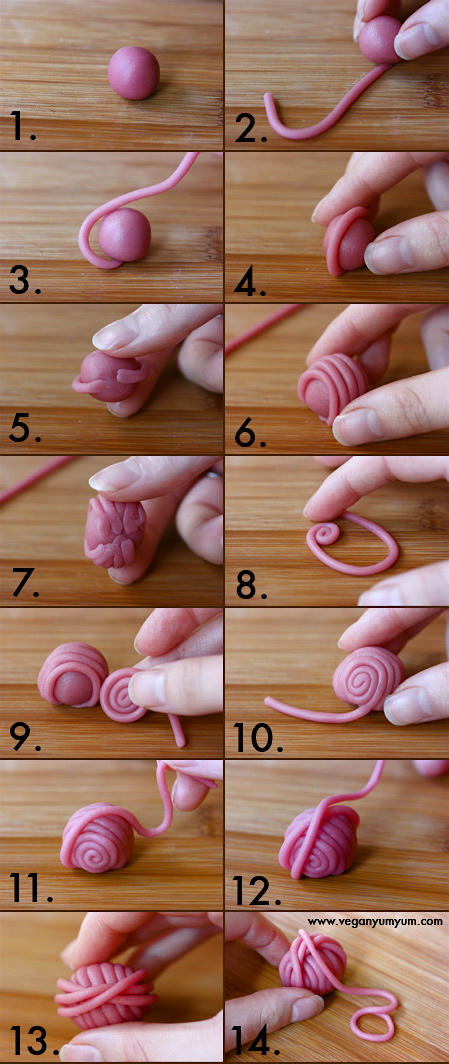
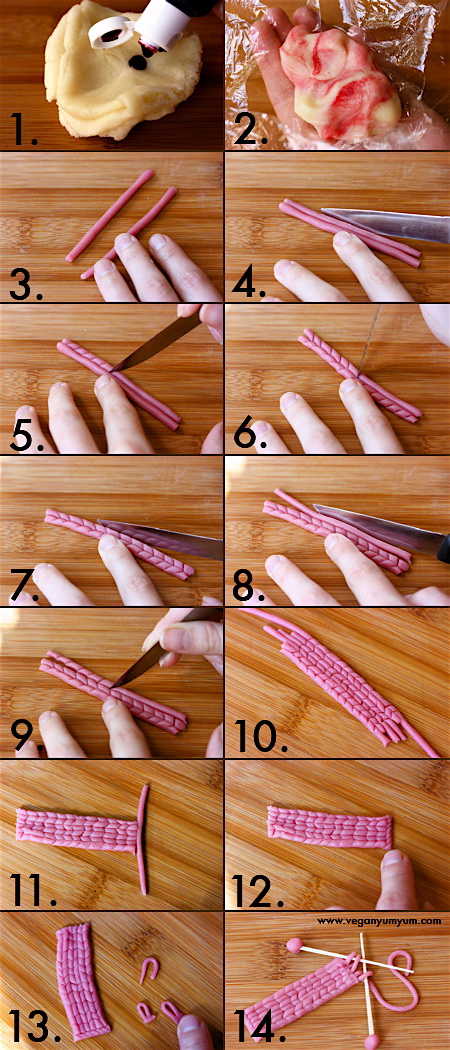
Knit Night Cupcakes - Yarn Balls If you're looking for the Knit Night Cupcakes that were featured on the Martha Stewart Show, the original post is here!

Email me at lolo AT veganyumyum DOT com

Fun Stuff

  • VeganYumYum Reader Flickr Pool
  • My Amazon.com Wish List
  • Calendar

    September 2010
    M T W T F S S
    « Jan    
     12345
    6789101112
    13141516171819
    20212223242526
    27282930  

    Posts by Month

    Posts by Category